
Insights explored in this article:
- Building sustainability is increasingly about operational intelligence, not just efficient equipment
- Intelligent lighting controls can unlock substantial energy savings without major building renovations
- Connected lighting creates sustainability value beyond energy reduction by enabling data-driven building management
For many years, improving building sustainability was largely viewed as a technology challenge. The formula seemed straightforward: replace inefficient equipment with more efficient alternatives, and energy consumption will fall.
To a large extent, this approach worked. The adoption of LED lighting, high-efficiency HVAC systems, and increasingly demanding building standards has delivered significant improvements in energy performance and helped organizations make progress towards their carbon reduction goals.
Yet despite these advances, a growing number of building owners are discovering that efficient equipment does not automatically create efficient buildings.
Many buildings today contain technologies capable of delivering excellent performance but still consume more energy than expected. Lighting remains active in underused spaces, systems continue to operate according to outdated schedules, and buildings often respond to assumptions about occupancy rather than actual conditions. As a result, the gap between designed performance and real-world performance is becoming increasingly apparent.
Focusing on actual building performance
This growing focus on how buildings perform in practice is reflected in both regulations and sustainability frameworks. In Europe, for example, the revised Energy Performance of Buildings Directive (EPBD) places increased emphasis on building performance, automation, and decarbonization. Buildings account for around 40 percent of EU energy consumption, while approximately 75 percent of EU buildings are considered energy inefficient, highlighting the scale of the challenge facing existing building stock.
While the EPBD provides a useful reference point, the underlying challenge is global. Similar priorities are emerging through building performance standards, net-zero strategies, ESG (environmental, social, and governance) programs, and voluntary certification frameworks such as BREEAM (Building Research Establishment Environmental Assessment Method) and LEED (Leadership in Energy and Environmental Design). Increasingly, these initiatives recognize that sustainability outcomes depend not only on efficient technologies, but also on how effectively those technologies are managed throughout a building’s lifecycle.
This shift is particularly significant because much of the building stock expected to be operating in 2050 already exists today. Achieving meaningful reductions in energy consumption and carbon emissions will therefore depend heavily on improving existing buildings, not simply constructing new ones. For many organizations, that raises an important question: where can meaningful improvements be achieved without major disruption?
Lighting is often one of the most practical answers.
From efficient to responsive lighting
Although frequently overlooked in broader sustainability discussions, lighting can account for approximately 20–30 percent of electricity consumption in many commercial buildings. It is also one of the few systems present in virtually every occupied space. Unlike many building upgrades, improvements to lighting controls can often be implemented with relatively little disruption to day-to-day operations, making them particularly attractive for retrofit projects. However, the most interesting opportunity is no longer the lighting equipment itself.
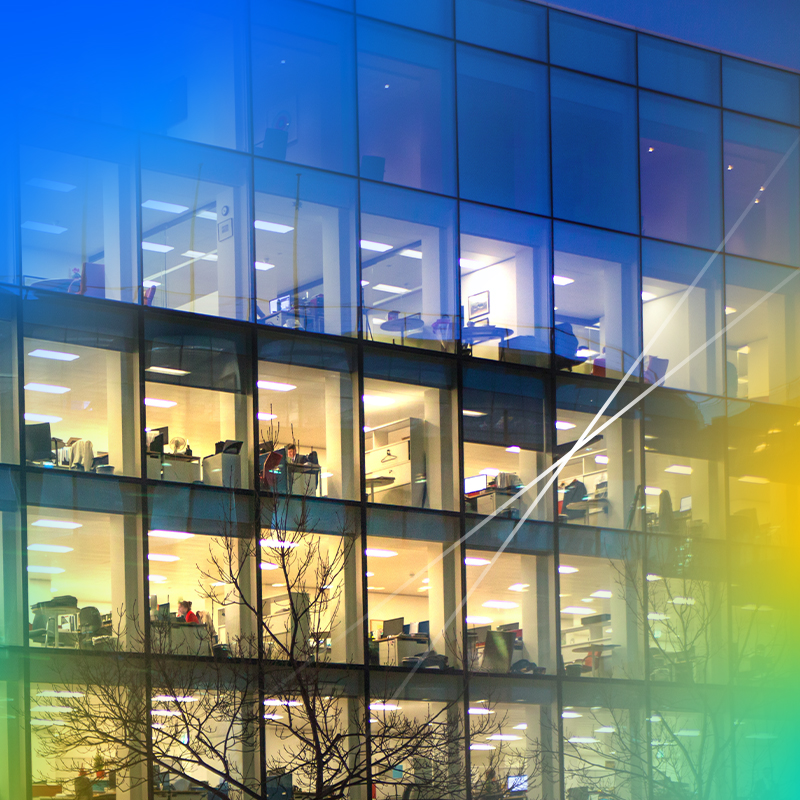
The widespread adoption of LED technology has fundamentally changed the conversation. The focus is increasingly shifting from how efficient luminaires are to how effectively lighting responds to the way buildings are actually used. This distinction is important.
A meeting room occupied for thirty minutes may remain illuminated for an entire day. An open-plan office designed for hundreds of people may only be partially occupied for much of the week. A warehouse may experience significant fluctuations in activity throughout a shift. In each case, the issue is not necessarily the efficiency of the lighting system, but whether the lighting responds to actual demand.
This is where controls become critical. Occupancy sensing, daylight harvesting, scheduling, and task tuning are all established approaches that help ensure lighting energy is consumed only when and where it is required. Depending on the building type and control strategy deployed, intelligent lighting controls can often reduce lighting energy consumption by 30–70 percent compared with uncontrolled installations.
Yet one of the most powerful opportunities is often one of the least discussed: zoning. Many buildings continue to control large areas as a single lighting zone, despite occupancy rarely occurring uniformly across an entire space. This can result in significant energy waste as lighting remains active to accommodate a small number of occupants.
As workplaces evolve through hybrid working, flexible occupancy patterns, and changing operational requirements, control strategies should evolve as well. In many situations, reviewing and refining lighting zones can unlock meaningful savings without replacing any lighting hardware.
Connected lighting as digital infrastructure
This highlights a broader lesson that extends beyond lighting itself. The next phase of sustainability will not be driven solely by technology upgrades. It will increasingly be determined by how intelligently buildings respond to changing conditions.
One reason connected lighting is attracting growing attention is that, historically, lighting systems were designed primarily to provide illumination. Today, they are increasingly being viewed as part of the wider digital infrastructure of a building.
Because lighting reaches virtually every occupied area, it provides a natural platform for sensing occupancy, understanding utilization patterns, and enabling automated responses. What was once largely an energy-consuming asset is becoming a source of operational insight.
To support this transition, devices need to communicate and share information. Standards-based wireless technologies have become an important enabler of this evolution, providing a foundation for connecting luminaires, sensors, and controls into coordinated systems capable of supporting intelligent operation.
Bluetooth® Networked Lighting Control (NLC) is one example of how this is being achieved. By enabling devices to communicate through a shared wireless network, Bluetooth NLC supports occupancy-based control, daylight-responsive operation, flexible zoning, and automated decision making across both new and existing buildings.
By enabling devices to communicate through a shared wireless network, Bluetooth® Networked Lighting Control supports occupancy-based control, daylight-responsive operation, flexible zoning, and automated decision making across both new and existing buildings.
Importantly, the value is not strictly connectivity itself but also lies in enabling lighting systems to adapt continuously to changing occupancy, environmental conditions, and patterns of use. Wireless deployment is particularly valuable within existing buildings, where reducing installation complexity can significantly improve the feasibility of retrofit projects.
From energy savings to operational insights
Interestingly, what organizations often discover after deployment extends far beyond energy reduction. Many projects begin with a simple objective: reduce electricity consumption.
Once connected systems are established, however, building owners frequently gain insights that were previously difficult to access. Occupancy information can reveal how meeting rooms are being used, highlight underutilized areas, or expose differences between assumed and actual building usage.
In commercial offices, this can help inform workplace planning and space utilization strategies. Within education facilities, it can improve understanding of how teaching spaces are used throughout the day. Healthcare facilities can use this information to balance energy efficiency with patient well-being and operational requirements. Industrial and logistics environments can better align building services with operational activity. What starts as a lighting project often develops into a broader conversation about building performance.
A practical example can be seen at Woluwe Shopping Centre in Brussels, Belgium. As part of a lighting refurbishment program, wireless connected lighting controls were implemented alongside an LED upgrade across parking and outdoor areas. While the LED installation delivered significant efficiency improvements, the control system contributed a further 74 percent reduction in energy consumption, resulting in an overall reduction of approximately 83 percent compared with the original installation.
Efficient equipment creates the opportunity for savings, but intelligent controls help organizations realize the full value of that investment.
The significance of this project extends well beyond the environment. It clearly demonstrates a principle that applies equally across offices, educational campuses, healthcare facilities, and industrial sites: efficient equipment creates the opportunity for savings, but intelligent controls help organizations realize the full value of that investment.
Supporting ESG objectives

This evolution also helps explain why connected lighting is increasingly being discussed in relation to ESG objectives. The environmental benefits are clear through reduced energy consumption and lower carbon emissions. Social benefits emerge through more responsive environments that support occupant comfort and wellbeing. Governance objectives benefit from access to measurable performance information that supports reporting, auditing, and evidence-based decision making.
Perhaps the most important shift, however, is that organizations increasingly have access to more information than ever before. The challenge is no longer collecting data but turning that information into meaningful action. Ultimately, sustainability is not only about consuming less energy. It is also about ensuring buildings remain capable of adapting to future requirements.
Buildings are long-term assets. Technologies, regulations, and organizational priorities will continue to evolve throughout their lifecycle. Systems that require wholesale replacement whenever requirements change create unnecessary cost, disruption, and waste.
For this reason, interoperability, scalability, and adaptability are becoming increasingly important sustainability considerations. Open, standards-based approaches help organizations protect investments, extend system lifecycles, reduce electronic waste, and maintain flexibility as requirements evolve.
Looking ahead: The future of building sustainability
The industry has spent much of the last decade improving the efficiency of building technologies. The next decade is likely to focus on something different: ensuring buildings make better use of those technologies.
For organizations looking to improve sustainability performance today, intelligent lighting controls represent one of the most practical and scalable starting points. They can reduce energy consumption, support BREEAM and LEED objectives, contribute to ESG goals, and provide the insights needed to support continuous improvement.
The most successful buildings of the future will not simply be those with the most efficient equipment. They will be the buildings that can understand, adapt, and improve over time, and connected lighting is increasingly becoming one of the foundations that enables that future.
