Industry experts provide insight into Bluetooth trends we can expect to see in 2026
|
Every year, Bluetooth® technology expands into new markets and use cases. 2025 was, of course, no exception, especially with increased momentum behind Bluetooth® Channel Sounding and Auracast™ broadcast audio. Moving into 2026, we coordinated with several Bluetooth member companies across a number of industries to better understand how they see current Bluetooth technology adapting or evolving to support emerging applications or markets in the coming year.
Looking ahead: Bluetooth® Channel Sounding

Bluetooth® Channel Sounding is a new secure, fine-ranging feature that promises to enhance the convenience, safety, and security of Bluetooth connected devices. By infusing billions of everyday devices with true distance awareness, Bluetooth® Channel Sounding unlocks a world of possibilities for developers, freeing them to imagine and create innovative experiences.
Shantanu Bhalerao, VP of wireless products at Infineon Technologies, says that Bluetooth® Channel Sounding is likely to be a popular feature in the coming years, especially for industrial applications and automotive digital key solutions. “Benefits like asset tracking, direction finding, and ease of device onboarding can have a big impact in the automotive and industrial space,” said Bhalerao. “These impacts directly contribute to simplifying existing architectures or increasing automation efficiency.”
According to Parker Dorris, staff product manager at Silicon Labs, despite it being a fairly recent release, just one year out from adoption, Bluetooth® Channel Sounding has already received widespread interest for use in industrial solutions. “We’re beginning to see how Bluetooth® Location Services solutions are driving new levels of productivity in industrial applications, particularly in asset tracking,” said Dorris. “The latest wave of innovation is being powered by Bluetooth® Channel Sounding, which enables highly precise location capabilities. By improving the ability to track assets, equipment, and personnel, Bluetooth is helping make industrial environments not only more efficient but also safer for workers.”
Øyvind Strøm, EVP of the short-range business unit at Nordic Semiconductor, says that they expect Bluetooth® Channel Sounding to expand further and wider into commercial and industrial spaces as more devices adopt this new Bluetooth feature, enabling widespread use of accurate and secure distance measurement in all connected applications. “Industrial innovation is entering a new phase of intelligence and precision, and Bluetooth is right at the center of it,” said Strøm, “In 2026, we expect to see Bluetooth® Channel Sounding enabling sub-meter asset tracking and guaranteeing worker safety through geofencing and safety zone functionalities.”
Looking ahead: Auracast™ broadcast audio
Auracast™ broadcast audio is a Bluetooth® capability that lets you share your audio, unmute silent TVs in public locations or in the comfort of your own home, and directly tune in to audio broadcasts to hear your best in public venues like airports, theatres, stadiums, etc.
Since its release, Auracast™ broadcast audio has proven itself across a diverse range of environments, including live theatre, music venues, houses of worship, and conferences. Deploying Auracast™ solutions in these locations creates opportunities to increase participation and accessibility through multi-channel broadcasts in native languages, high-quality sound, descriptive audio, and more.
Transforming everyday spaces
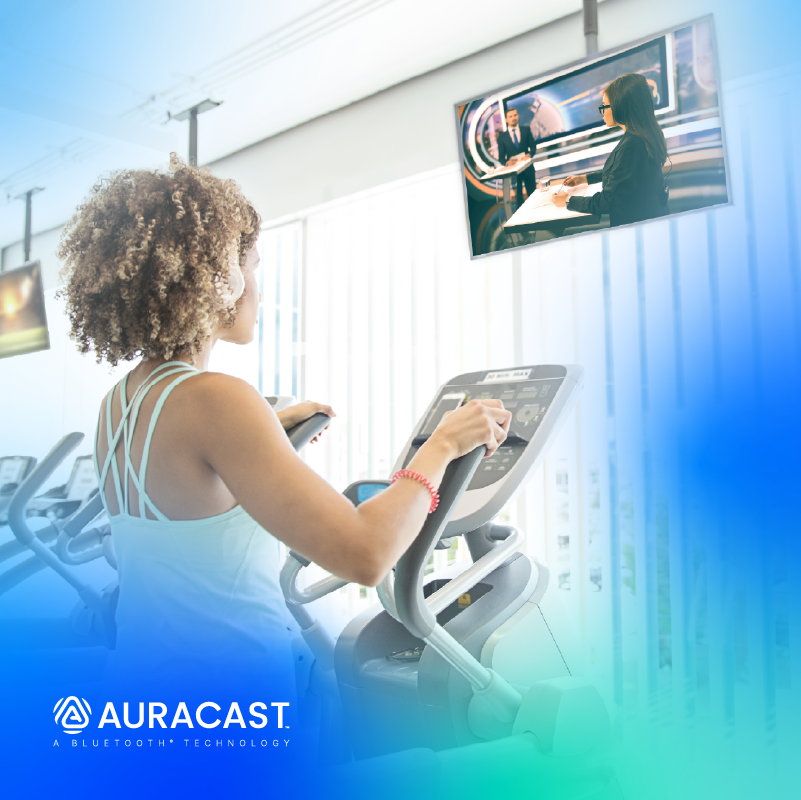
As we move forward into 2026 and beyond, Auracast™ broadcast audio will continue to transform public spaces, helping more venues become inclusive. Thomas Olsgaard, principal engineer at GN, states that as adoption increases, Auracast™ broadcast audio will create even more opportunities to transform everyday spaces, including supermarkets, schools, and hospitals, and make inclusive listening universal to ensure the day-to-day lives of people with hearing loss are positively impacted. “It will help entire communities share the same, high-quality audio together,” said Olsgaard. “That promise of inclusion where no one is left out of the conversation, the music, or the moment is what excites us most.”
Raviv Kramer, director of product and business development for AV at Bettear, says that they are seeing strong interest across universities, as decision makers are beginning to understand that Auracast™ solutions deliver far more than wireless audio and that they can significantly enhance the performance of speech-to-text engines. “As the technology becomes more popular and rapidly adopted, more places are going to offer this experience,” said Kramer. “Auracast™ broadcast audio is becoming the standard for hearing accessibility everywhere.”
According to Chuck Sabin, VP of technology and market development at the Bluetooth SIG, Auracast™ broadcast audio has injected new excitement and momentum across the audio and assistive listening ecosystem, enabling distributors and installers to think bigger and broader about the solutions they are providing. “Auracast™ broadcast audio is the best thing that has happened for assistive listening and audio accessibility in a long time,” said Sabin. “While some locations may still decide to install Auracast™ alternatives, or just update current systems, there is no question the impact Auracast™ broadcast audio is having on the ecosystem and raising awareness for assistive listening, in general.”
Improved personal listening experiences
Advancements in Auracast™ broadcast audio will open the door for more personalized and interactive experiences. As broadcast capabilities and latency improve, the listening experience will become seamless. Kim Franklin, Ampetronic and Listen Technologies CMO, says that we can expect to see richer audio, faster connections, and new opportunities for synchronized experiences across a wide range of spaces. “Imagine walking through an airport or museum and hearing exactly what’s relevant to you in real time,” said Franklin.
As Auracast™ enabled devices continue to proliferate the market, Auracast™ broadcast audio will power bring-your-own-device (BYOD) initiatives in public spaces. This creates a more intuitive and personal experience for each visitor while simplifying maintenance by reducing the amount of dedicated hardware a facility needs to maintain and keep on hand.
Looking ahead: High data throughput & ultra-low latency HID
The Bluetooth Special Interest Group (SIG) typically has more than 50 active specification development projects at any given time. These projects include everything from adding minor features to existing Bluetooth specifications to creating new specifications that add major functionality to Bluetooth® wireless technology. Two of the most anticipated releases are the high data throughput and ultra-low latency HID.
“The convergence of the ultra-low latency HID project, the high data throughput project, and the higher bands project is setting the stage for a new generation of Bluetooth enabled experiences,” said Øyvind Strøm from Nordic Semiconductor.
High data throughput
Today, Bluetooth devices are looking for even greater performance as well as the ability support streaming of even larger media and could benefit from an even higher data rate Bluetooth LE PHY. The high data throughput project was established to address this growing market need and intends to support data rates up to 8 Mbps.
According to Strøm, Nordic Semiconductor expects high data throughput to enable a wide range of new throughput-intensive applications for Bluetooth in 2026 and beyond. “High data throughput will unlock new markets in data-intensive, real-time applications where bandwidth and responsiveness are critical, in high-fidelity wireless audio, and in applications requiring large media sharing over the air,” said Strøm.
Parker Dorris, from Silicon Labs, says that high data throughput pushes the upper boundaries of performance through new PHYs and protocol enhancements. “This and other Bluetooth features focus on unlocking applications where a user requires Bluetooth to deliver more, whether it’s higher-fidelity audio or larger files transmitting faster over a Bluetooth link,” said Dorris.
Bluetooth® technology stands apart because of its remarkable versatility, spanning residential, commercial, industrial, automotive, and even non-terrestrial applications…Bluetooth is a key part of shaping a future where technology feels natural, accessible, and efficient.
PARKER DORRIS, SILICON LABS
Ultra-low latency HID
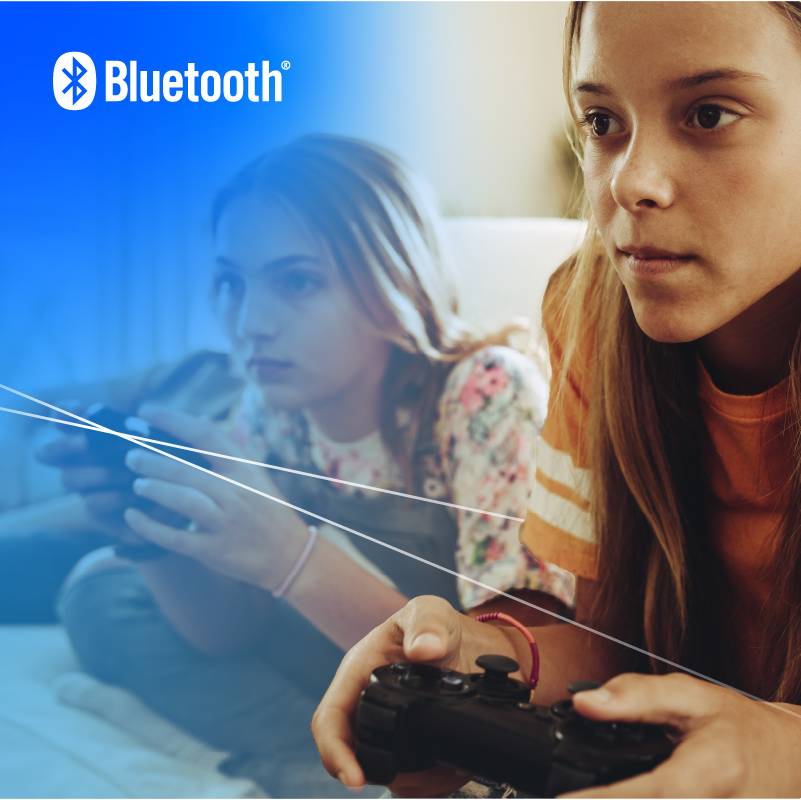
The ultra-low latency (ULL) human interface device (HID) enhancement project aims to make Bluetooth gaming controllers as responsive as those using USB-wired or proprietary wireless communications. This enhancement, which intends to support polling rates as high as 1000 Hz, could also be used to improve the user experience for other latency-sensitive devices, including controllers and sensors for augmented, virtual, or mixed reality (AR/VR/MR) scenarios.
Shantanu Bhalerao, from Infineon Technologies, says that combining high data throughput and low latency (lower interframe spacing) will open the possibility for many latency and bandwidth-dependent products like AR/VR headsets, high-performance gaming peripherals, or high-fidelity wireless audio products to be truly wireless (without a dongle).
Øyvind Strøm, from Nordic Semiconductor, says that ultra-low latency HID, powered by Bluetooth® Shorter Connection Intervals, will redefine responsiveness in gaming, creative tools, and medical devices. “These advancements are not just incremental; they are foundational to the next wave of immersive and intelligent low-latency wireless products,” said Strøm. “This major improvement in connection interval lengths and thus polling rates makes Bluetooth LE gaming mice and keyboards more tempting than ever for both competitive and casual gaming.”
Looking ahead: AI and Bluetooth® connectivity
Many Bluetooth features, such as Bluetooth® Channel Sounding and Bluetooth® Mesh Networking, continue to drive innovation in industrial and smart building applications, especially when paired with edge AI for real-time decision making. These technologies are helping to expand Bluetooth from a communication protocol into a platform for ambient intelligence.
According to Shantanu Bhalerao, from Infineon Technologies, edge AI has unlocked a whole new potential of what Bluetooth enabled products can do. The lower latency, lower power consumption, and greener operation edge AI can support pairs well with the benefits Bluetooth technology already offers. “Bluetooth® connectivity is at the heart of enabling edge AI and will help lead the next-set of intelligent, power-efficient edge solutions,” said Bhalerao.
Health and wellness
With on-device intelligence enhanced by AI, a wearable can detect conditions, such as arrhythmia, apnea, stress spikes, or falls as they happen, and provide instant alerts or interventions. For example, a smartwatch might use AI to analyze subtle heart rate variability (HRV) changes, signaling dehydration or fatigue, and proactively suggest rest or hydration. This real-time, AI-driven feedback has the potential to enable biofeedback loops, increasing user engagement and improving outcomes in fitness, mindfulness, or rehabilitation.
“It has been interesting to see how quickly edge AI and computing on the edge started picking up pace and how fast it is already being integrated into wireless products using Bluetooth® technology, such as smartwatches, smart rings, fitness trackers, and other wireless wearables,” said Øyvind Strøm from Nordic Semiconductor. “Features like gesture recognition, heart-rate analysis, predictive analytics, and personalized insights are in high demand in the market, and the pace of their progress has been astounding. Looking ahead to 2026, we’re expecting products combining AI with Bluetooth profiles to enable predictive use cases where latency and context-awareness are critical.”
Looking ahead to 2026, we’re expecting products combining AI with Bluetooth profiles to enable predictive use cases where latency and context-awareness are critical.
Øyvind Strøm, Nordic Semiconductor

Auracast™ broadcast audio
Industry experts agree that AI and machine learning have the potential to further optimize Auracast™ solutions, enhancing speech clarity for high-quality, inclusive listening experiences without added complexity. When combined with edge computing, they can make Auracast™ broadcasts smarter and more adaptive.
According to Raviv Kramer, at Bettear, AI and machine learning can be used not only to improve the quality of audio but also to translate it, match it with transcription, perform voice transformation, filter words, and enhance speech. “We have opened a speech-to-text pathway for Auracast™ systems in our transceivers,” said Kramer. “Our R&D team is working on advanced approaches to audio personalization for those with hearing or perception challenges, including individuals with hearing loss, ADHD, cognitive decline, and more. In the future, this capability will be integrated with the Auracast™ ecosystem to create a personally tuned audio stream for the listener, maximizing their immersion.”
Kim Franklin, at Ampetronic and Listen Technologies, sees AI playing a growing role in managing large-scale installations, predictive maintenance, adaptive audio profiles, and data-driven insights to ensure every listener gets the best experience possible.
Bluetooth connections help create a better world
Moving into 2026, Bluetooth® technology will continue to expand and support even more consumer, commercial, and industrial applications through its innovative capabilities.
Parker Dorris, from Silicon Labs, says ambient IoT initiatives will use Bluetooth connectivity for new applications where the user requires the device to operate with less and energy harvesting will enable limited, often connectionless Bluetooth communication. “Bluetooth® technology stands apart because of its remarkable versatility, spanning residential, commercial, industrial, automotive, and even non-terrestrial applications,” said Dorris. “Its durability and ubiquity make it one of the most impactful wireless technologies, and, fortunately, its impact continues to be profoundly positive for people and the planet. Bluetooth is a key part of shaping a future where technology feels natural, accessible, and efficient.”
Thanks to a dedicated global member community, Bluetooth is well-positioned to overcome new challenges and continue to transform businesses, drive industries, and enrich lives.
