Automotive Market Blueprint Proposal
Bluetooth® Market Blueprint Proposal
- Version: v1.0
- Version Date: 2026-07-20
- Prepared By: Strategic Technology Advisory Committee (STAC)
Abstract:
This Automotive Market Blueprint Proposal is a forward-looking market analysis that helps translate Automotive market needs into guidance for shaping the long-term Bluetooth technology roadmap. It provides a comprehensive overview of how Bluetooth can expand its role in automotive applications over the next five to seven years. It defines key focus areas, use cases, technical enablers, and proposed phases to help ensure that Bluetooth remains an essential technology within the automotive ecosystem.
This document, regardless of its title or content, is not a Bluetooth Specification as defined in the Bluetooth Patent/Copyright License Agreement (“PCLA”) and Bluetooth Trademark License Agreement. Use of this document by members of Bluetooth SIG is governed by the membership and other related agreements between Bluetooth SIG Inc. (“Bluetooth SIG”) and its members, including the PCLA and other agreements posted on Bluetooth SIG’s website located at www.bluetooth.com.
THIS DOCUMENT IS PROVIDED “AS IS” AND BLUETOOTH SIG, ITS MEMBERS, AND THEIR AFFILIATES MAKE NO REPRESENTATIONS OR WARRANTIES AND DISCLAIM ALL WARRANTIES, EXPRESS OR IMPLIED, INCLUDING ANY WARRANTY OF MERCHANTABILITY, TITLE, NON-INFRINGEMENT, FITNESS FOR ANY PARTICULAR PURPOSE, THAT THE CONTENT OF THIS DOCUMENT IS FREE OF ERRORS.
TO THE EXTENT NOT PROHIBITED BY LAW, BLUETOOTH SIG, ITS MEMBERS, AND THEIR AFFILIATES DISCLAIM ALL LIABILITY ARISING OUT OF OR RELATING TO USE OF THIS DOCUMENT AND ANY INFORMATION CONTAINED IN THIS DOCUMENT, INCLUDING LOST REVENUE, PROFITS, DATA OR PROGRAMS, OR BUSINESS INTERRUPTION, OR FOR SPECIAL, INDIRECT, CONSEQUENTIAL, INCIDENTAL OR PUNITIVE DAMAGES, HOWEVER CAUSED AND REGARDLESS OF THE THEORY OF LIABILITY, AND EVEN IF BLUETOOTH SIG, ITS MEMBERS, OR THEIR AFFILIATES HAVE BEEN ADVISED OF THE POSSIBILITY OF SUCH DAMAGES.
This document is proprietary to Bluetooth SIG. This document may contain or cover subject matter that is intellectual property of Bluetooth SIG and its members. The furnishing of this document does not grant any license to any intellectual property of Bluetooth SIG or its members.
This document is subject to change without notice.
Copyright © 2026 by Bluetooth SIG, Inc. The Bluetooth word mark and logos are owned by Bluetooth SIG, Inc. Other third-party brands and names are the property of their respective owners.
Version History
| Version Number | Date (yyyy-mm-dd) | Comments |
|---|---|---|
| v1.0 | 2026-07-20 | Initial public release of the Automotive Market Blueprint Proposal. |
Acknowledgments
| Company |
|---|
| STAC participants: Apple Inc., Google LLC, Huawei Device Co., Ltd., Intel Corporation, MediaTek, Microsoft Corporation, Nordic Semiconductor ASA, Qualcomm, Silicon Laboratories, Telink Semiconductor (Shanghai) Co., Ltd, Texas Instruments Incorporated, and Xiaomi Inc. |
| ABI Research |
| Bluetooth SIG Automotive Working Group |
| Bluetooth SIG Mesh Working Group |
1. Purpose
The automotive industry is undergoing a significant transformation driven by electrification, shared mobility, and the rise of software-defined vehicles (SDVs). As vehicles evolve from hardware-centric to software-driven platforms, the networking backbone is transitioning from legacy CAN and LIN buses to Ethernet and IP-based zonal architectures. Bluetooth technology, with its combination of low power consumption, interoperability, and ubiquity, is uniquely positioned to complement these changes by serving as the human-centric connectivity fabric inside and around the vehicle.
This Automotive Market Blueprint Proposal is a forward-looking market analysis that helps translate Automotive market needs into guidance for shaping the long-term Bluetooth technology roadmap. It provides a comprehensive overview of how Bluetooth can expand its role in automotive applications over the next five to seven years. It defines key focus areas, use cases, technical enablers, and proposed phases to help ensure that Bluetooth remains an essential technology within the automotive ecosystem.
2. Four Pillar Analysis
The following Four Pillar Analysis (Core Assets, Vulnerabilities, Market Potential, Risk Factors) exercise for Bluetooth technology in Automotive and Transport was conducted by the STAC for added context to the requirements discussed in this document.
This analysis is not meant to be exhaustive or all-encompassing to every factor impacting Bluetooth technology in Automotive and Transport. It is meant as a guide to help provide context and background to the blueprint proposal discussion.
2.1 Core Assets (Internal Positive Factors)
- Ubiquity in Infotainment: Bluetooth is the de facto standard for hands-free calling and media streaming in vehicles, ensuring baseline presence in nearly every passenger vehicle shipped globally.
- Ecosystem Familiarity: Consumers, automakers, and Tier 1s are deeply familiar with Bluetooth, reducing friction in implementation and user adoption.
- Energy Efficiency at Scale: Bluetooth LE offers low power consumption, ideal for key fobs, tire pressure sensors, and other always-on modules.
- Broad Device Compatibility: Seamless integration with smartphones and aftermarket devices (e.g. OBD dongles) enhances the value of existing vehicle systems.
2.2 Vulnerabilities (Internal Negative Factors)
- Ethernet Enablement in the Car: Automotive to an IP backbone for big and small harness solutions.
- Inconsistent Performance in Vehicle Environments: Metal-intensive interiors and complex cabin layouts can constrain signal strength, affecting reliability for new and emerging use cases.
- Security & Proximity Limitations: Compared to UWB and NFC, LE-based vehicle access and authentication may face scrutiny around spoofing and range-based vulnerabilities.
- Fragmentation Across Implementations: OEM-specific adaptations (e.g. priority PaaK flows) reduce interoperability and make it harder to drive standardization.
- Latency Sensitivity for Safety Use Cases: Current LE latency may not meet the performance thresholds required for time-critical use cases like V2X coordination.
2.3 Market Potential (External Positive Factors)
- Growth in Electrification & Smart Infrastructure: As EV adoption accelerates, Bluetooth can play a role in smart charging coordination, driver identification, and V2G (Vehicle-to-Grid) interfaces.
- Personalized User Experiences: LE enables user profile recall, passenger-specific content, and in-cabin automation.
- Fleet & Commercial Telematics: LE-connected diagnostics, usage tracking, and condition monitoring represent a high-volume opportunity in logistics and fleet operations.
- Sensor Network Enablement: Emerging interest in Bluetooth mesh inside the vehicle could open new device categories (e.g. TPMS, occupancy, ADAS, BMS, smarthome).
- Leverage Car Access Integration: Bluetooth is being widely adopted for car access either in combination with UWB, NFC or standalone with Channel Sounding. This puts infrastructure in the car that can be leveraged to integrate additional functionality with no cost, weight or space added.
2.4 Risk Factors (External Negative Factors)
- Rise of Alternate Radio Technology: Automakers are investigating alternative technology options to meet requirements for secure access, localization, and communication, which may, over the long term, displace or limit Bluetooth’s role in new and existing Bluetooth use cases.
- Regulatory Pressures: Evolving privacy, RF, and security regulations (especially in Europe and Asia) could impose compliance challenges on Bluetooth-enabled vehicle systems.
- OEM Standardization Fatigue: Differing levels of Bluetooth implementation maturity across OEMs may slow progress on cross-platform standards like Digital Key or mesh-based sensor integration.
- User Experience Expectations: Rising consumer expectations around instant connectivity, precise location, and seamless app experiences may stretch current Bluetooth capabilities.
3. Use Cases and Technical Enablers
The shift to an Ethernet-based zonal architecture, and the future of sensor and control system reflects a fundamental rethinking of vehicle design. These architectures can reduce wiring complexity, improve modularity, and support real-time over-the-air (OTA) software updates. Simultaneously, vehicles are expected to provide more intelligence, personalization, and connectivity, enabling seamless interaction between occupants, devices, infrastructure, and the cloud.
Bluetooth’s broad deployment base across smartphones, wearables, and embedded devices creates an opportunity for deep integration into SDV ecosystems. As a human-interface and wireless extension technology, Bluetooth bridges physical and digital environments, connecting people, vehicles, and smart infrastructure securely and efficiently.
At the same time, audio, infotainment and hands-free enablement have been the core to the ubiquity of Bluetooth technology in the automobile. The SIG needs to understand and manage the transition of audio and in-vehicle entertainment from Bluetooth Classic to Bluetooth LE Audio.
For the purpose of this blueprint, the use case opportunities and technical enablers for automotive fall into four distinct categories.
- Automotive transition to Ethernet — and away from CAN (infrastructure)
- Inside the car communication transformation and wire reduction
- Vehicle to X (V2X) communications
- Audio/Infotainment/Phone direction to LE Audio
3.1 Category 1: Automotive Transition to Ethernet
Objective:
Enable Bluetooth integration within Ethernet-based, IP-centric vehicle architectures.
Why it matters:
As automakers move toward Ethernet and zonal control architectures, Bluetooth must evolve from a peripheral link to a core wireless component that bridges service tools, sensors, and provisioning processes to the Ethernet backbone. This integration allows for faster updates, reduced cabling, and simplified vehicle serviceability.
Requirements:
- Become IP-aware — integrate seamlessly with Ethernet/zonal backbones.
- Provide standardized LE-to-Ethernet gateways for diagnostics, provisioning, and sensor integration.
- Align security and QoS with Ethernet/TSN standards.
- Deliver ultra-low-power wireless “branch” connections that reduce wiring while maintaining reliability.
- Demonstrate interoperability within AUTOSAR, SDV, and OEM Ethernet test environments.
Outcome:
Bluetooth functions as a secure, wireless edge to Ethernet networks, supporting diagnostics, provisioning, and firmware updates where physical access is limited.
Use Cases
| Use Case | Description |
|---|---|
| Aftermarket diagnostics via dongles | Bluetooth enables wireless diagnostic access to vehicle ECUs, replacing wired OBD tools and supporting diagnostics over IP-style service data exchange. |
| Basic fleet asset tracking (trucks, buses, delivery vehicles) | LE sensors and gateways provide real-time vehicle location, health, and usage data for fleet management systems. |
| TPMS and other sensors (over LE) | Low-energy Bluetooth links transmit status and environmental data to the vehicle’s zonal controller or central ECU. |
| Pairing with personal mobility (e-bikes, scooters, delivery devices) | Vehicles and logistics hubs use LE for authentication, data sync, and coordination with connected personal mobility assets. |
| Wireless service tools / technician diagnostics | Service technicians connect securely via LE to access vehicle status, perform maintenance, and update configurations without cables. |
| Secure firmware update triggers via Bluetooth gateway | LE gateway initiates authenticated, encrypted firmware updates through the Ethernet backbone or cloud services. |
| Wireless configuration and commissioning of zonal controllers | During assembly or service, zonal ECUs are wirelessly configured, reducing physical connector use and wiring complexity. |
| Factory provisioning or calibration through Bluetooth bridges | Bluetooth bridges support early-stage production provisioning, calibration, and test routines before the full Ethernet network is active. |
Technical Enablers
| Objective | What Bluetooth Needs | Why It Matters |
|---|---|---|
| IP-native operation | Support for IPv6 transport and service discovery directly over Bluetooth (beyond PAN) | Ethernet backbones are fully IP-based; Bluetooth devices must appear as addressable nodes for diagnostics, telemetry, and OTA provisioning |
| Gateway integration | Standardized LE-to-Ethernet or LE-to-IP bridge profile | Allows Bluetooth peripherals (sensors, tools) to connect seamlessly into Ethernet domain controllers |
| Higher throughput & deterministic latency | Optimization of LE Isochronous Channels, increased PHY rates (2 M, potential 4 M) | Competes with short CAN-FD links for configuration or low-rate telemetry |
| Quality-of-Service and TSN alignment | Mapping Bluetooth QoS to Ethernet TSN (Time-Sensitive Networking) parameters | Helps ensure predictable timing when data traverses from wireless to wired domains |
| Robust coexistence | Enhanced interference management with Wi-Fi 6E/7 and automotive radar | Ethernet networks coexist with dense RF; Bluetooth must maintain link integrity in noisy environments |
Category Specific Phases
| Phase | Key Enablers | Example Use Cases | Bluetooth Needs |
|---|---|---|---|
| Phase 1 – Foundation: Wireless Diagnostics and Maintenance Near term (0–2 years) | LE GATT-based diagnostics, IP-over-LE gateway integration | Aftermarket dongles, technician wireless access, service-mode diagnostics | Define LE diagnostic and provisioning profiles, secure pairing and authentication, OEM acceptance for service tools |
| Phase 2 – Gateway Bridging and IP Awareness Short term (1–3 years) | LE-to-Ethernet gateway profiles, IPv6 support over LE, improved throughput (LE 2M PHY) | Integration of Bluetooth tools into Ethernet-based domain controllers, wireless ECU provisioning | Standardized LE-to-Ethernet translation, IP service discovery, security alignment with Ethernet PKI |
| Phase 3 – Wireless Edge Nodes for Zonal Systems Mid term (2–5 years) | LE mesh integration with zonal controllers, automotive QoS, coexistence management | Wireless connectivity for edge modules (sensors, body electronics) within zonal domains | Mesh QoS mapping, interference mitigation with Wi-Fi/UWB, deterministic LE scheduling |
| Phase 4 – IP-Based Diagnostic and Service Infrastructure Long term (4–6 years) | LE IP gateway architecture, TSN and Ethernet QoS interoperability, IP extensions | Wireless service and configuration across vehicle Ethernet backbone | Define LE QoS models compatible with TSN, integrate LE nodes into Ethernet-based diagnostic frameworks |
| Phase 5 – Software-Defined Vehicle Integration (Future Vision) 5+ years | Unified management of wired/wireless domains, IP-based service orchestration, OTA over LE | Full integration into SDV platforms, mixed LE and Ethernet data domains | SDV orchestration support, cross-radio policy management, predictive maintenance via LE-enabled service networks |
3.2 Category 2: Inside-the-Car Communication and Wire Reduction
Objective:
Replace short wired harnesses with deterministic, reliable Bluetooth LE networks (e.g. mesh) for sensors and actuators.
Why it matters:
Automakers are seeking to reduce weight, simplify manufacturing, enhance modularity and increase scalability (e.g. cell-level expansion in BMS). Bluetooth LE offers a scalable and flexible alternative to wired harnesses, enabling distributed zonal architecture and improved serviceability.
Requirements:
- Deliver deterministic, automotive-grade mesh networking to replace short wired runs.
- Provide IP-aware gateway integration with zonal Ethernet controllers.
- Achieve reliability, latency, and security parity with wired CAN/LIN.
- Define standard automotive profiles for sensors and actuators.
- Embed Bluetooth connectivity deeper into the vehicle architecture — not just infotainment, but in every zone.
Outcome:
Bluetooth serves as a wireless sub-network fabric, reducing wiring complexity while maintaining deterministic communication performance.
Use Cases
Big Harness — Functional Area
| Functional Area | Description |
|---|---|
| Diagnostics & Maintenance | LE used by technicians or service equipment to reach ECUs without a wired connection |
| Battery / Powertrain Telemetry | Used for status, firmware info, or health monitoring between modules |
| Sensor Aggregation / Environmental Monitoring | Low-power LE sensors report to a zonal ECU over LE rather than wired |
| Zonal Controller Provisioning | Simplifies manufacturing and replacement of zone controllers |
| Gateway Bridge to Ethernet | Connects local wireless sub-nets into the IP backbone |
Small Harness — Functional Area
| Functional Area | Description |
|---|---|
| Seat Systems | LE mesh between switches, motors, and ECU for automated settings and adjustments |
| HVAC Modules | LE mesh reduces wire count and complexity |
| Lighting / Interior Comfort | Wireless control from zone ECU |
| Door Systems | LE sub-network for moving assemblies |
| Cabin Sensing | Battery-powered LE sensors networked locally |
Technical Enablers
| Requirement | What’s Needed | Impact |
|---|---|---|
| Deterministic Performance | < 10 ms latency and bounded jitter for actuator control | Competes with CAN/LIN timing expectations |
| Mesh for Automotive | Robust, self-healing mesh with QoS, diagnostics, and address management | Enables scalable sensor/actuator clusters |
| Improved Reliability | Automotive-grade coexistence with Wi-Fi 6/7 and UWB | Essential in dense RF cabins |
| Low Power + High Battery Life | Deep-sleep modes, fast reconnection, sub-milliamp idle | Needed for embedded or battery sensors |
| Extended Range and Penetration | Adaptive power control and antenna diversity | Reliable link through metal body structures |
| Security Equivalence to Wired | Hardware-based encryption, authenticated pairing, PKI alignment | OEMs require same safety and privacy assurance as wired links |
| Time Synchronization | Sub-millisecond clock alignment across nodes | Required for coordinated actions (lighting, seat movement, etc.) |
Category Specific Phases
| Phase | Key Enablers | Example Use Cases | Bluetooth Needs |
|---|---|---|---|
| Phase 1 – Foundation: Wireless Diagnostics and Provisioning Near term (0–2 years) | LE GATT-based diagnostics, IP over LE, secure commissioning | Wireless diagnostics via service tools, ECU configuration, manufacturing provisioning | Standard LE diagnostic profile, secure authentication and pairing, OEM service adoption |
| Phase 2 – Sensor Integration and Environmental Monitoring Short term (1–3 years) | LE Mesh enhancements, Coded PHY for extended range, low-power sensor nodes | Cabin environmental sensors (CO₂, temperature, occupancy), localized telemetry | Standardized sensor profiles, optimized low-power mesh operation, automotive certification |
| Phase 3 – Wireless Actuator Control (Small Harness Replacement) Mid term (2–5 years) | Deterministic LE Mesh, low-latency isochronous control, automotive-grade QoS | Wireless door, seat, HVAC, and lighting control; LIN/CAN wire reduction | Mesh profile definition, latency <10 ms, strong coexistence with Wi-Fi/UWB, embedded zone ECU integration |
| Phase 4 – Zonal Controller Integration (Big Harness Interface) Long term (4–6 years) | LE–Ethernet gateway bridging, Time-Sensitive Networking (TSN) alignment, IP routing integration | Wireless sub-net aggregation, ECU-to-ECU communication, zonal coordination | LE-to-Ethernet gateway specification, QoS mapping to TSN, IP addressing and service discovery support |
| Phase 5 – Software-Defined Vehicle and Hybrid Networks (Future Vision) 5+ years | Software-defined service layer for wireless zones, cross-radio orchestration, OTA reconfiguration | Dynamic, software-defined in-vehicle networks; reconfigure LE wireless sub-systems | Integration with SDV frameworks, unified management of LE + Ethernet domains, predictive maintenance via wireless diagnostics |
3.3 Category 3: Vehicle to X (V2X) Communications
Objective:
Extend Bluetooth connectivity beyond the vehicle to include people, infrastructure, and smart devices.
Why it matters:
Bluetooth can complement cellular V2X (C-V2X) by providing cost-effective, short-range communication for awareness, safety, and accessibility. With billions of compatible devices already deployed, Bluetooth can extend the V2X ecosystem to pedestrians, cyclists, and micro-mobility users.
Requirements:
- Evolve from consumer-centric pairing to secure broadcast and ranging at scale.
- Define a V2X profile suite (covering V2D, V2P, V2I, V2G).
- Integrate channel sounding, Auracast-style broadcast, and PKI security into automotive stacks.
- Deliver automotive-grade performance (≤ 50 ms latency, ∼200 m range, > 99.9% availability).
- Position Bluetooth as the ubiquitous short-range complement to C-V2X and 5G, focusing on accessibility, safety awareness, and infrastructure interaction.
Outcome:
Bluetooth serves as a ubiquitous, human-centric connectivity layer for proximity-based safety, accessibility, and interaction.
Use Cases
| V2X Segment | Description |
|---|---|
| V2-Device | Digital key standardization (across OEMs); ride-share or rental authentication (phone or badge-based); driver/passenger profile handoff via personal device |
| V2-Pedestrian | Pedestrian and cyclist safety alerts (LE advertisements from phones or wearables); crosswalk presence signals |
| V2-Infrastructure (V2I) | Smart parking meters, tolls, traffic-signal communication; contactless ticketing/boarding for public transport; connected roadside beacons |
| V2-Network (V2N) | Vehicle status upload via LE-to-phone gateway when out of coverage; crowdsourced road-condition data |
| V2-Grid (V2G) | Smart-charging handshake between vehicle and charger; fleet load balancing for depot management |
| V2-Emergency / Safety | Emergency-vehicle pre-emption signals; location-aware rescue or occupant status broadcast |
Technical Enablers
| Requirement | Target | Rationale |
|---|---|---|
| End-to-end latency | ≤ 50 ms (alert path) | Comparable to C-V2X for non-critical awareness alerts |
| Range | 150–200 m (Line of Sight with Coded PHY) | Covers urban crossings and parking infrastructure |
| Throughput | ≤ 500 kbps | Adequate for control and status data |
| Localization accuracy | ≤ 1 m with Channel Sounding | Enables keyless entry and proximity safety |
| Availability | > 99.9% link reliability | Automotive grade dependability |
| Low Power Operation | “Increased years of life on battery type” | Enable continuous location awareness for digital key and other LE Scan/Adv and CS Initiator/Reflector |
| Concurrency ranging | 5 devices or more; some automotive OEMs require minimum of 8 devices | Enables multiple Anchors for digital car key for localization of device |
| Regulatory Requirements | TBD | Concurrent use of technology in 2.4 and upper bands (coexistence, fair use) |
Category Specific Phases
| Phase | Key Enablers | Example Use Cases | Bluetooth Needs |
|---|---|---|---|
| Phase 1 – Foundation: Proximity and Identity Near term (0–2 years) | LE Secure Connections, Digital Key 3.0 (CCC), Coordinated device authentication | Digital Key for vehicle access, phone/badge-based fleet or rideshare authentication, driver profile personalization | Standardized LE V2X profile set, automotive-grade security integration, OEM adoption across brands |
| Phase 2 – Awareness and Safety (V2P & V2D) Short term (1–3 years) | LE Advertisements, Coded PHY (LE Long Range), Channel Sounding for ranging | Pedestrian/cyclist safety alerts, wearable-based proximity warnings, presence detection in parking and loading zones | Integration of Channel Sounding, sub-meter proximity accuracy, privacy-preserving broadcast authentication |
| Phase 3 – Infrastructure and Transactional Connectivity (V2I & V2N) Mid term (2–5 years) | LE broadcast extensions (broadcast for data), IP gateways to Ethernet/5G, PKI-based certificate management | Parking, tolling, ticketing, smart traffic beacons, fleet data exchange, contactless public transport | Standardized LE-to-IP bridging, secure provisioning and certificate lifecycle management, coexistence with Wi-Fi and 5G |
| Phase 4 – Energy and Ecosystem Integration (V2G & Edge) Long term (4–6 years) | LE hybrid connectivity, ISO 15118-20 handshake via LE, cloud-edge coordination | Vehicle-to-grid charging coordination, depot load balancing, wireless energy handshakes | LE support for ISO 15118-20 protocols for EV and EVSE, interoperability with grid systems, authentication frameworks for energy services |
| Phase 5 – Human-Centric Smart Mobility (Future Vision) 5+ years | Converged broadcast (Auracast + Data), Edge AI and cloud synchronization, integrated multi-radio V2X | Seamless public transport experiences, adaptive accessibility services, contextual audio and safety cues | Multi-radio orchestration (LE + Wi-Fi + C-V2X), integration into SDV and Smart City frameworks, global interoperability standards |
3.4 Category 4: Audio/Infotainment/Phone direction to LE Audio
Objective:
Transition to multi-zonal architecture and support for varied in-vehicle roles (driver, passenger, guest), including transition from Classic Audio to LE Audio as the foundation for multi-zone, shared, accessible, and guest in-vehicle experiences.
Why it matters:
LE Audio and Auracast™ enable synchronized, high-quality audio streams with reduced latency. This supports personalized infotainment, accessibility, and shared audio use cases aligned with software-defined infotainment platforms.
Requirements:
- Full LE Audio Adoption Across Vehicle Architectures: OEMs must migrate from BR/EDR (A2DP/HFP) to LE Audio (ISO / LC3 / Auracast).
- Backward Compatibility Strategy: Helps ensure mixed LE Audio + Classic support for multi-generation devices during transition.
- Multi-Zone Audio Profile: Define automotive-specific extensions for synchronized multi-stream management (front / rear / passenger zones).
- Auracast Data Extensions: Standardize metadata (e.g., language, location, priority) to support public or shared mobility broadcast audio.
- Advanced Device Management: Standardize multi-phone pairing, handoff and guest behaviors across OEMs — including seamless rental and ride-share experiences.
Outcome:
Bluetooth LE Audio provides high-quality, low-latency, inclusive audio experience across all in-vehicle and public transport environments.
Use Cases
| Segment | Example Use Cases |
|---|---|
| Core Infotainment Audio | Hands-free calling, media streaming, voice-assistant audio |
| Multi-Device Pairing & Profile Continuity | Multiple phones connected (driver + passenger), automatic profile detection |
| LE Audio and Auracast Broadcast | Multi-zone or shared listening (front/rear/passenger), public-announcement audio |
| Personal Audio Zones (multi-zone) | Driver vs. passenger content isolation (music vs. call), personalized EQ |
| Hearing Health & Accessibility | Auracast announcements in buses, airports, or public fleets; hearing-aid compatibility |
| Passenger Entertainment | Wireless earbuds/headphones connected to seatback or rear-zone units, surround sounds, HR/LL support |
| Vehicle Companion Device Integration | Smartwatch, phone, tablet continuity (notifications, calls, media control) |
| Public Transport / Shared Vehicle Audio | Broadcast audio for route updates or ambient announcements |
Technical Enablers
| Requirement | What’s Needed | Impact |
|---|---|---|
| Low-Energy Isochronous Channels (ISO) | Core LE Audio foundation for synchronous audio streams | Enables multiple synchronized, power-efficient streams |
| Multi-Stream Audio | Simultaneous ISO links between source and multiple sinks | Smooth hand-offs, driver/passenger differentiation |
| Audio Quality | HR/LL | Increase audio quality experience. |
| Auracast™ Broadcast Audio | One-to-many audio distribution | Supports in-vehicle announcements or public transport broadcasts |
| QoS and Connection Management | Enhanced scheduling and prioritization | Required to handle multiple audio streams plus data control |
| Low-Latency Control Plane | Coordinated LE ISO and control channels | Maintains call and media quality during switching, gaming and other LL scenarios |
| Secure Pairing and Encryption | Improved LE Security Mode 1 Level 4 (ECDH + AES-CCM) | Helps protect personal audio and profile data |
| Integration with Voice Assistants | Standardized Audio Input and Media Control Services | Helps ensure compatibility with ecosystem assistants |
| Interoperability with Hearing Devices | Hearing Aid Profile (LE Audio) alignment | Supports regulated accessibility features |
| In-Car Location Awareness | Identifying individual user location inside the car | Personalized experience, driver vs. passenger, front seat versus rear seat access experiences |
Category Specific Phases
| Phase | Key Enablers | Use Cases | Bluetooth Needs |
|---|---|---|---|
| Phase 1 – LE Audio Foundation Short term (0–2 years) | LC3 codec, LE Isochronous Channels, LE Secure Connections, Coordinated Set Identification (CSI) | LE Audio integration in infotainment, multi-device pairing, seamless switching between phone and vehicle | OEM integration toolkit, Android/CarPlay compatibility |
| Phase 2 – Multi-Zone and Personalized Audio Mid term (2–4 years) | Multi-stream audio over LE Isochronous Channels, low-latency synchronization, profile personalization | Multi-zone cabin audio, personal audio profiles, seamless experience across devices | Reliable multi-stream sync (<2 ms), Wi-Fi/UWB coexistence, automotive-grade certification |
| Phase 3 – Auracast™ Broadcast Audio and Accessibility Long term (3–6 years) | Auracast™ broadcast channels, assisted discovery, Hearing Access Profile (HAP), public broadcast interoperability | Shared passenger listening, accessibility audio, multilingual broadcasts | Integration of Auracast transmitters, OEM adoption, automotive-grade discovery APIs |
| Phase 4 – Cross-Transport and Cloud-Integrated Audio (Future Vision) 5+ years | Cross-transport handoff (LE↔Wi-Fi/IP), cloud-managed user profiles, SDV audio service integration | Seamless audio continuity (home–phone–car), cloud-synced personalization, fleet/rideshare personalization | IP transport extensions, SDV alignment, collaboration with Wi-Fi Alliance and OS vendors |
4. Automotive Blueprint Proposal
In this section we attempt to merge the four categories discussed in Section 3, offering a view across common technical enablers and merged prioritization of development phases of the blueprint over the next five to seven years.
4.1 Common Technical Enablers Across Categories
| Technical Enabler | What It Enables | Why It Matters Across Categories |
|---|---|---|
| 1. IP-Native Operation (IPv6 over LE) | Seamless integration with Ethernet and SDV backbones | Enables Bluetooth devices to appear as IP-addressable nodes; critical for diagnostics, zonal integration, and cloud continuity |
| 2. LE-to-Ethernet / LE-to-IP Gateways | Bridges between low-power wireless and high-speed wired domains | Connects LE peripherals and sub-nets to zonal controllers and vehicle compute; foundational for transition to ethernet and in-car communications |
| 3. Deterministic Low-Latency Mesh Networking | Reliable, synchronized sensor/actuator communication | Needed for wire-replacement inside cabin and body systems and to support safety-relevant timing |
| 4. Enhanced Security and PKI Integration | Certificate-based authentication, encrypted provisioning | Required everywhere — diagnostics, digital keys, LE Audio pairing, and SDV fleet management |
| 5. LE Channel Sounding / Ranging | Accurate distance and proximity estimation (< 1 m) | Underpins Digital Key, presence detection, occupant awareness, and secure access experiences |
| 6. QoS / TSN Alignment | Mapping LE QoS to Ethernet TSN parameters | Helps ensure predictable timing and prioritization when LE traffic traverses Ethernet backbones |
| 7. Broadcast Architecture (Auracast™ Extensions) | One-to-many data and audio distribution | Central for LE Audio and V2X safety beacons or accessibility broadcasts |
| 8. Multi-Radio Coexistence Management | Adaptive spectrum coordination with Wi-Fi 6/7, UWB, C-V2X | Helps prevent interference across all domains — infotainment, sensing, and V2X |
| 9. Automotive-Grade Reliability and Environmental Hardening | Wide-temperature, EMI-tolerant PHY and antenna design | Required for all in-vehicle deployments, especially zonal controllers and sensors |
| 10. Power-Efficient, Event-Driven Operation | Ultra-low-power communication modes for sensors and accessories | Extends viability of LE nodes in large wireless subnetworks |
| 11. Time Synchronization & Clock Alignment | Sub-millisecond sync across devices and zones | Enables multi-zone audio (Category 4) and coordinated sensor networks |
| 12. Inter-Transport Continuity | Seamless handoff between LE, Wi-Fi, and IP transports | Critical for persistent experiences across phone–vehicle–cloud ecosystems |
| 13. Standardized Automotive Profiles | Defined profiles for diagnostics, sensors, actuators, V2X messages | Reduces fragmentation; improves adoption across OEMs and Tier-1 suppliers (all categories) |
| 14. Cloud & SDV Integration APIs | APIs for OTA updates, telemetry, and service orchestration | Enables Bluetooth to participate in software-defined vehicle lifecycle management |
4.2 Integrated Five-Phase Blueprint (5-7+ Year)
Focus: Sequence technical enablers in a way that aligns with the industry’s move towards ethernet/zonal architectures, software-defined vehicles (SDV), and human-centric connectivity (V2X + LE Audio). Deliver a logical progression: foundation >> integration >> optimization >> ecosystem expansion >> SDV convergence.
| Phase | Objective | Focus | Key Enablers Introduced |
|---|---|---|---|
| Phase 1 – Foundation (Year 0–1) | Establish baseline capability for: 1) wireless diagnostics, service tools, 2) Zonal architecture and role of Bluetooth in audio and personalized infotainment. (The “magic experience” of entering the vehicle.) | • Automotive-grade LE hardware (temperature, EMI hardened) • LE Secure Connections + PKI integration • Standardized diagnostic and provisioning profiles • LE Audio base adoption • Driver/Passenger determination and preference | Creates a secure, reliable foundation for wireless connectivity within Ethernet-ready vehicles. Demonstrates near-term value in diagnostics and infotainment. |
| Phase 2 – Network Integration (Year 1–3) | Enable Bluetooth to act as an edge component of Ethernet/zonal networks. | • LE-to-Ethernet/IP gateways • IP-native operation (IPv6 over LE) • QoS alignment with Ethernet TSN • Mesh enhancements for reliability | Bluetooth becomes a recognized “wireless edge” for zonal controllers — supporting service, sensor, and actuator data flows. |
| Phase 3 – Deterministic Mesh & Ranging (Year 2–4) | Deliver predictable, low-latency, high-integrity wireless for in-car systems and proximity-based services. | • Deterministic LE Mesh (sub-10 ms latency) • Channel Sounding / Ranging (sub-meter accuracy) • Time synchronization across devices • Improved coexistence (Wi-Fi 6/7, UWB) | Enables wire-replacement for small harnesses, and proximity-aware applications like Digital Key and ride-share authentication. |
| Phase 4 – Broadcast & Ecosystem Expansion (Year 3–5) | Expand Bluetooth’s reach into public, shared, and infrastructure domains. | • Auracast™ broadcast extensions for data & audio • Hearing Access Profile (HAP) integration • PKI for broadcast authentication • LE long-range (Coded PHY) for V2P/V2I | Bluetooth evolves into a ubiquitous broadcast platform for shared listening, accessibility, and V2X awareness. |
| Phase 5 – SDV & Multi-Transport Convergence (Year 5+) | Integrate Bluetooth into software-defined vehicle and smart-mobility ecosystems. | • Cross-transport continuity (LE <> Wi-Fi/IP) • Unified cloud-service API for OTA and telemetry • Predictive diagnostics via LE + Ethernet orchestration • Multi-radio orchestration & policy management | Bluetooth becomes a fully integrated SDV subsystem — interoperable with Wi-Fi, 5G, and cloud services for seamless human-vehicle experiences. |
4.3 Strategic Justification and Priority
This blueprint aligns Bluetooth’s evolution with the automotive industry’s transition to Ethernet and software-defined vehicles. It positions Bluetooth not as a competitor to 5G or Wi-Fi but as a complementary, human-centric connectivity layer. By enabling deterministic, secure, and cloud-integrated wireless communication, Bluetooth will continue to be foundational to user experience, diagnostics, accessibility, and mobility innovation.
5. Summary Outcome: Bluetooth in Software-Defined Vehicles (SDV)
SDVs rely on orchestrated, cloud-managed services that continuously update and personalize the user experience. Following this blueprint, and taking all categories into account, Bluetooth plays a key role as the continuity layer bridging user identity, vehicle personalization, and cloud intelligence.
The following identifies many of the benefits and value of Bluetooth in SDV.
5.1 Edge Connectivity Layer
- Bluetooth provides low-power wireless access between the SDV’s zonal controllers and distributed edge devices (sensors, actuators, accessories).
- Acts as the “last meter” link where Ethernet is impractical.
- Enables wireless diagnostics, configuration, and provisioning at the edge.
- Allows over-the-air calibration or data exchange without physical connectors.
5.2 Identity, Access, and Personalization Services
- Bluetooth becomes part of the SDV’s user-identity framework, integrating with cloud credentials and PKI systems.
- Digital Key / proximity authentication using LE and Channel Sounding.
- Seamless driver profile handoff (seat, infotainment, climate, apps) via LE.
- Supports fleet and mobility platforms where identity is dynamic and cloud-managed.
5.3 Audio, Accessibility, and Human Interface Layer
- As SDVs separate hardware from software, Bluetooth LE Audio and Auracast™ provide multi-zone audio routing managed by the SDV’s central software stack.
- Shared or broadcast audio for passengers and accessibility users.
- API-driven audio control instead of fixed head-unit pairing logic.
5.4 Data and Service Orchestration (SDV Middleware Integration)
- Bluetooth nodes become IP-addressable participants in the vehicle’s service mesh.
- LE-to-IP gateways let SDV middleware discover, monitor, and update Bluetooth devices.
- Enables unified diagnostics, telemetry, and OTA updates across wired and wireless domains.
- Contributes sensor data to SDV analytics or AI modules through the same service fabric.
5.5 Cross-Transport and Cloud Continuity
- Bluetooth acts as a persistent continuity layer across devices, vehicles, and cloud services.
- LE <> Wi-Fi handoff supports seamless transitions between personal and in-vehicle sessions.
- Cloud-synced profiles preserve user settings across multiple SDVs or shared vehicles.
- Future SDV ecosystems can orchestrate Bluetooth connections through cloud APIs, ensuring consistent user experience.
6. Cross ecosystem collaboration on SDVs
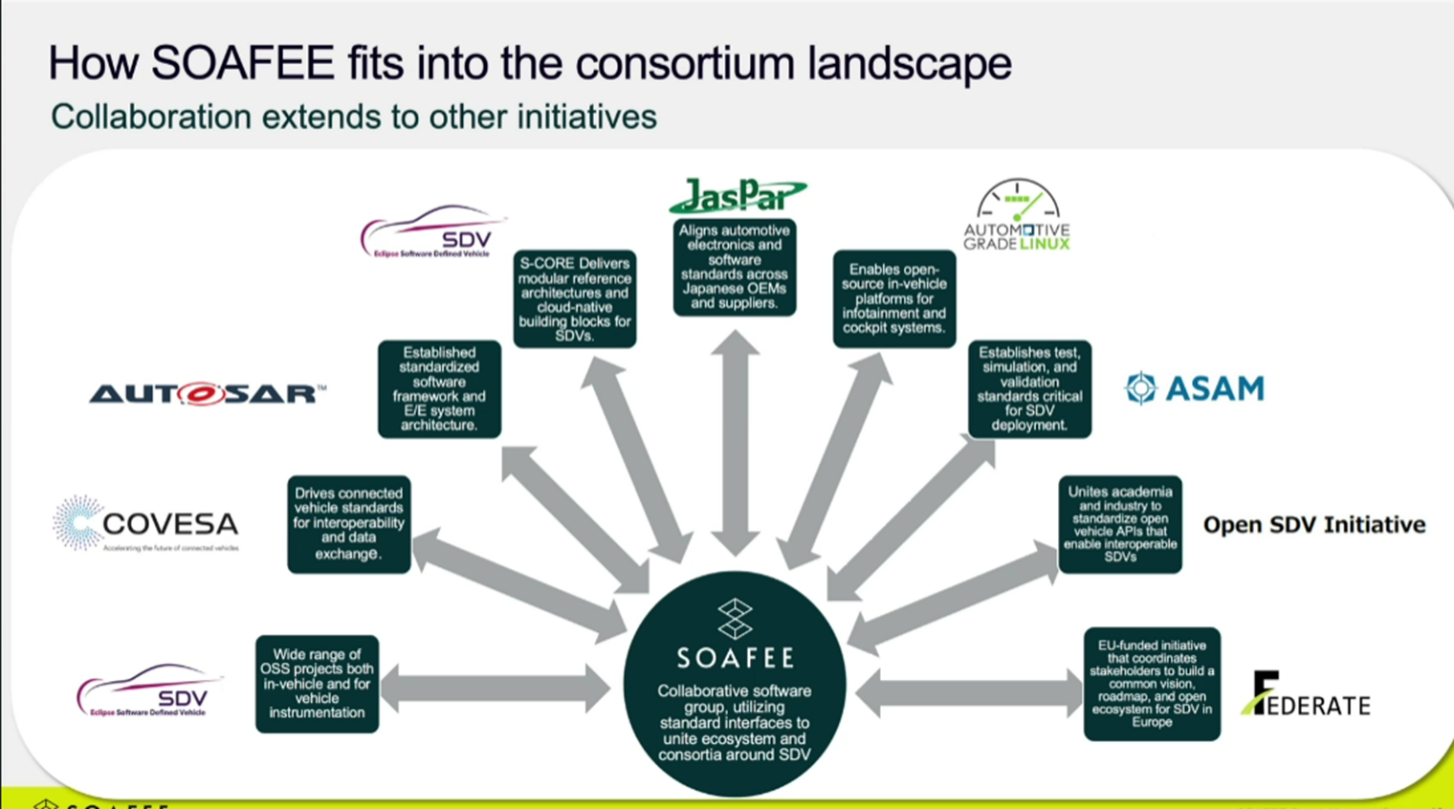
The following diagram from SOAFEE (soafee.io) illustrates many of the organizations and SDOs working on requirements for SDV and network integration. It may benefit the Bluetooth SIG to coordinate and potentially enter into liaison relationships with a number of these organizations to help execute and fulfill on the vision and path to success identified in this blueprint.