Bluetooth® technology is expanding to support the next generation of connected vehicles
|

Insights explored in this article:
- Bluetooth® technology is evolving from an infotainment solution into a foundational connectivity platform for connected vehicles
- The transition to software-defined vehicles and Ethernet-based architectures is creating new opportunities for Bluetooth connectivity
- Future automotive growth for Bluetooth technology will come from new vehicle applications rather than traditional infotainment
As vehicles evolve into software-defined platforms, the role of wireless connectivity is expanding well beyond infotainment and hands-free communications. Already present in all new vehicles, Bluetooth® technology is increasingly being positioned to support digital access, vehicle personalization, diagnostics, and next-generation vehicle architectures.
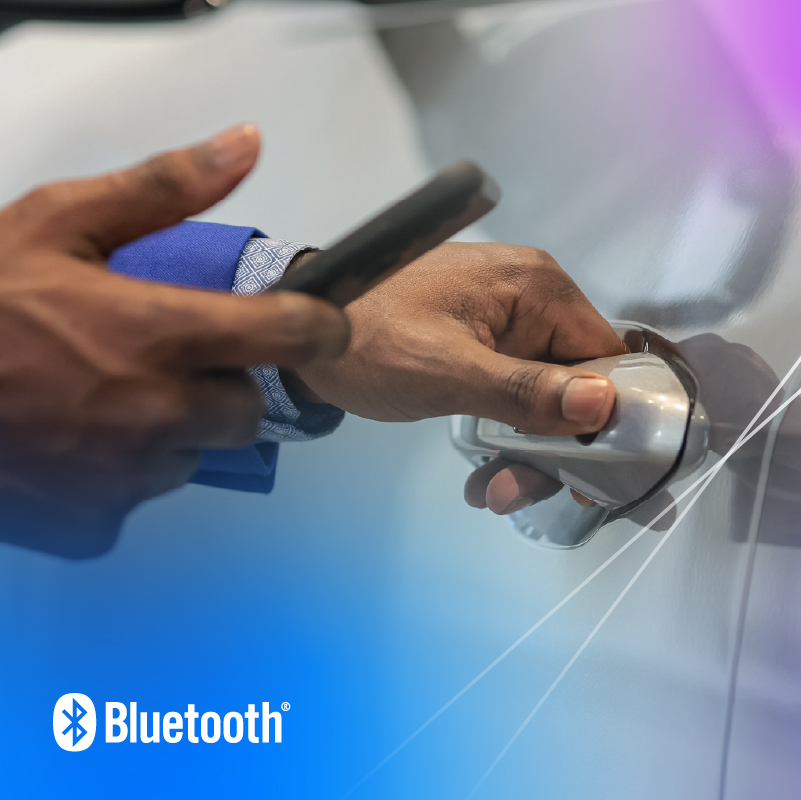
While in-car infotainment remains a foundational use case, the automotive industry is increasingly exploring vehicle personalization, connected services, and other applications. Recent industry activity has also focused on standardizing secure digital key solutions, with organizations such as the Car Connectivity Consortium incorporating Bluetooth® technology into digital key implementations. Secure digital key systems are increasingly being viewed as a foundational capability for connected vehicles, enabling smartphone-based access, shared vehicle access models, and improved user convenience.
Bluetooth growth in automotive
The growth of Bluetooth® connectivity across in-car infotainment has nearly fully matured. Today, the attach rate is at 93 percent and is expected to reach 96 percent by 2030 (ABI Research). However, analysts predict that there is still tremendous opportunity for Bluetooth technology to further support innovation in the automotive market.
The role of Bluetooth technology is expanding from simply connecting smartphones to infotainment systems to enabling phones, sensors, service tools, and other connected devices to function as addressable endpoints within the vehicle ecosystem. According to ABI Research, the biggest growth driver moving forward for Bluetooth connectivity in automotive will be in key fobs and accessories. ABI Research forecasts 73 percent growth for Bluetooth connectivity in key fobs alone between now and 2030.
ABI Research forecasts 73% growth for Bluetooth connectivity in key fobs alone between now and 2030.
While infotainment remains the largest automotive application for Bluetooth technology today, growth opportunities are increasingly emerging in next-generation vehicle architectures.
Automotive transition to Ethernet
Electrification, shared mobility, and software-defined vehicles (SDVs) are reshaping the automotive industry. As software increasingly differentiates the vehicle experience, OEMs must deliver over-the-air updates, strengthen cybersecurity, and create seamless digital experiences while shortening development cycles. These changes are driving a transition away from legacy controller area network (CAN) and local interconnect network (LIN) buses toward Ethernet and IP-based zonal architectures capable of supporting more centralized and data-intensive vehicle systems.
Traditional CAN networks were designed for vehicles with fewer connected systems. Modern vehicles generate and exchange much more data, which can put pressure on CAN-based communication architectures. As such, automotive Ethernet is increasingly being adopted as a networking foundation capable of supporting centralized computing, over-the-air updates, and other data-intensive vehicle functions.
Bluetooth connectivity in next-gen automotive
In next-generation architectures, Bluetooth connectivity can serve as a wireless access layer that connects service tools, sensors, and provisioning workflows to the vehicle’s underlying Ethernet network. This enables technicians, manufacturing systems, and connected devices to interact with vehicle systems without requiring dedicated physical connections for every function.
By integrating Bluetooth connectivity into Ethernet-based, IP-centric vehicle architectures, automakers can create a secure wireless edge system that extends network access beyond traditional wired interfaces. This approach has the potential to streamline software provisioning and diagnostics processes, reduce the amount of wiring required throughout the vehicle, and simplify service operations by enabling wireless access to vehicle subsystems. As SDVs continue to evolve, Bluetooth technology can help bridge the gap between wireless devices and the vehicle’s high-performance network infrastructure, supporting more flexible deployment, maintenance, and lifecycle management processes.
A broader opportunity for Bluetooth in automotive
Emerging opportunities include digital access, wireless diagnostics, Ethernet-based service architectures, V2X communications, and next-generation audio experiences enabled by Bluetooth® LE Audio and Auracast™ broadcast audio.
Bluetooth SIG members can access additional insights into these emerging automotive opportunities by watching the automotive market blueprint, while Contributing Adopter and Associate members can participate in the Bluetooth SIG Automotive Working Group to help evaluate opportunities, advance new work proposals, and shape the future of Bluetooth technology in automotive. With the role of wireless connectivity expanding across the vehicle, now is an exciting time to get involved and help shape what comes next.
Learn more about becoming a member and join the Bluetooth SIG.
