
-
Version: v1.1.1
-
Version Date: 2015-12-15
-
Prepared by: Car WG
Revision History
|
Revision |
Date |
Comments |
|---|---|---|
|
0.1 |
08-Sep-00 |
First draft |
|
0.2 |
29-Nov-00 |
Alignment with Specification Description; Procedures described in more detail; Comments from Raghunandan Sanjeev added. |
|
0.3 |
29-Jan-01 |
Serial Port and Generic Access Control Profile Interoperability Requirements rewritten; Comments from J. Pulido added. |
|
0.31 |
05-Feb-01 |
Comments from P. Breyer and K. Ulery added. |
|
0.4 |
13-Mar-01 |
Features and Procedures reorganized:
Parameter list and Message coding added. |
|
0.45 |
04-Apr-01 |
Comments from Bilbao face-to-face meeting added. Document reorganized for better readability. |
|
0.49 |
16-Apr-01 |
Test Strategy added. Renaming from Remote Authentication Access to SIM Access Profile done. Message coding changed. Proposal for 0.5 version. |
|
0.50 (preBARB) |
28-May-01 |
Editorial changes after Car WG review Proposal for review by BARB |
|
0.50 |
19-Jun-01 |
Editorial changes after BARB review |
|
0.60 |
20-July-01 |
Changes in the procedures after discussion in the July 19th phone conference |
|
0.61 |
30-July-01 |
All changes accepted; other comments from WG members added |
|
0.65 |
01-August-01 |
Editorial changes in document: Connection setup and Status Report procedures modified |
|
0.66 |
29-August-01 |
State Machine introduced Better definitions of ResultCode and StatusChange added Payload of ERROR_RESP simplified Byte ordering conventions added |
|
0.69 |
14-Sept-01 |
Changes in Sections 7.3 Link Manager Interoperability Requirements and 7.4 Link Control Interoperability Requirements Protocol Stack (Section 2.1) and Message Example (Section 5.4) added Editorial changes in Sections 4.6 - 4.8 and 4.13 |
|
0.699 |
26-Sept-01 |
Changes after comments from Raghu and Michael |
|
0.70 |
27-Sept-01 |
Document approved as 0.70 by the Car Working Group |
|
0.80 |
20-Nov-01 |
Editorial changes:
Changes w.r.t. the features "Power SIM on/off", "Reset SIM" and "Transfer ATR". |
|
0.81 |
17-Dec-01 |
Changes after review during San Francisco f-2-f meeting |
|
0.90 |
21-Dec-01 |
Draft version for Working Group approval |
|
0.90a |
04-Jan-02 |
Further improvements of the 0.90 draft: "Power SIM off" procedure has been made optional |
|
0.90b |
10-Jan-02 |
Comments from Jesus Pulido on Rev. 0.90a incorporated |
|
0.90c |
01-Feb-02 |
Comments from BARB review incorporated |
|
0.95VD |
22-Mar-02 |
Voting Draft |
|
0.95VD b |
18-Apr-02 |
Voting Draft with changes in Security Section (2.5) |
|
0.95VD c |
16-May-02 |
Voting Draft with changes after BARB, BQRB and BTI review |
|
0.95VD d |
17-Sep-02 |
Updates to allow access to UICC as well |
|
0.95VD e |
03-Oct-02 |
Updated to use generic term for all cards; Updated to allow access to R-UIM also |
|
0.95VD f |
13-Nov-02 |
Changed generic term Module to Subscriber Module |
|
1.00 VD |
22-Dec-04 |
Voting Draft |
|
D10r01 |
02-Feb-05 |
Updated for technical editing |
|
D10r02 |
15-Feb-05 |
Updates after BARB review |
|
V10r03 |
12-May-05 |
Adopted by the BoD |
|
D11r04 |
30-Aug-07 |
Updates for core spec 2.1+EDR |
|
D11r05 |
15 May 08 |
Update SDP version number and solution for spec errata 2564 |
|
D11r06 |
16 May 08 |
Updates for errata 2564 |
|
D11r07 |
28 May 08 |
Change profile dependency chart and address TB comments |
|
D11r08-12 |
01 July 08 |
Minor corrections and comments addressed |
|
V11r00 |
18 Dec 08 |
Adopted by the Bluetooth SIG Board of Directors |
|
d1.1.1 |
19 Nov 15 |
ESR09 (integrated E5659) |
|
v1.1.1 |
15 Dec 15 |
Adopted by the Bluetooth SIG BoD |
Contributors
|
Name |
Company |
|---|---|
|
Penny Breyer |
Cambridge Silicon Radio Ltd. |
|
Björn Bunte |
Nokia Corp. |
|
Lowell Campbell |
Denso Corp. |
|
Patrick Clauberg |
Nokia Corp. |
|
Christian Gehrmann |
Ericsson Mobile Communications AB |
|
Holger Krummel |
Nokia Corp. |
|
Holger Lenz |
Berner & Mattner Systemtechnik GmbH |
|
Tony Mansour |
Motorola, Inc. |
|
Ganesh Pattabiraman |
Qualcomm Inc. |
|
Jesus-Angel Gonzalez Pulido |
Ericsson España, S.A. |
|
Daniel S. Rokusek |
Motorola, Inc. |
|
Raghunandan Sanjeev |
Motorola, Inc. |
|
Burch Seymour |
Continental Automotive Systems |
|
Kazu Suzuki |
Denso Corp. |
|
Michael Svob |
Motorola, Inc. |
|
Yoichiro Takeuchi |
Toshiba Corp. |
|
Dmitri Toropov (owner) |
Siemens AG |
|
Patrick Reinelt |
Siemens AG |
|
Kreg Ulery |
Agere Systems |
|
Monica Wifvesson |
Ericsson Mobile Communications AB |
|
Joachim Mertz |
Berner & Mattner |
DISCLAIMER AND COPYRIGHT NOTICE
This disclaimer applies to all draft specifications and final specifications adopted by the Bluetooth SIG Board of Directors (both of which are hereinafter referred to herein as a Bluetooth “Specification”). Your use of this Specification in any way is subject to your compliance with all conditions of such use, and your acceptance of all disclaimers and limitations as to such use, contained in this Specification. Any user of this Specification is advised to seek appropriate legal, engineering or other professional advice regarding the use, interpretation or effect of this Specification on any matters discussed in this Specification.
Use of Bluetooth Specifications and any related intellectual property is governed by the Promoters Membership Agreement among the Promoter Members and Bluetooth SIG (the “Promoters Agreement”), certain membership agreements between Bluetooth SIG and its Adopter and Associate Members, including, but not limited to, the Membership Application, the Bluetooth Patent/Copyright License Agreement and the Bluetooth Trademark License Agreement (collectively, the “Membership Agreements”) and the Bluetooth Specification Early Adopters Agreements (1.2 Early Adopters Agreements) among Early Adopter members of the unincorporated Bluetooth SIG and the Promoter Members (the “Early Adopters Agreement”). Certain rights and obligations of the Promoter Members under the Early Adopters Agreements have been assigned to Bluetooth SIG by the Promoter Members.
Use of the Specification by anyone who is not a member of Bluetooth SIG or a party to an Early Adopters Agreement (each such person or party, a “Member”) is prohibited. The use of any portion of a Bluetooth Specification may involve the use of intellectual property rights ("IPR"), including pending or issued patents, or copyrights or other rights. Bluetooth SIG has made no search or investigation for such rights and disclaims any undertaking or duty to do so. The legal rights and obligations of each Member are governed by the applicable Membership Agreements, Early Adopters Agreement or Promoters Agreement. No license, express or implied, by estoppel or otherwise, to any intellectual property rights are granted herein.
Any use of the Specification not in compliance with the terms of the applicable Membership Agreements, Early Adopters Agreement or Promoters Agreement is prohibited and any such prohibited use may result in (i) termination of the applicable Membership Agreements or Early Adopters Agreement and (ii) liability claims by Bluetooth SIG or any of its Members for patent, copyright and/or trademark infringement claims permitted by the applicable agreement or by applicable law.
THE SPECIFICATION IS PROVIDED “AS IS” WITH NO WARRANTIES WHATSOEVER, INCLUDING ANY WARRANTY OF MERCHANTABILITY, NONINFRINGEMENT, FITNESS FOR ANY PARTICULAR PURPOSE, SATISFACTORY QUALITY, OR REASONABLE SKILL OR CARE, OR ANY WARRANTY ARISING OUT OF ANY COURSE OF DEALING, USAGE, TRADE PRACTICE, PROPOSAL, SPECIFICATION OR SAMPLE.
Each Member hereby acknowledges that products equipped with the Bluetooth wireless technology ("Bluetooth Products") may be subject to various regulatory controls under the laws and regulations applicable to products using wireless non licensed spectrum of various governments worldwide. Such laws and regulatory controls may govern, among other things, the combination, operation, use, implementation and distribution of Bluetooth Products. Examples of such laws and regulatory controls include, but are not limited to, airline regulatory controls, telecommunications regulations, technology transfer controls and health and safety regulations. Each Member is solely responsible for the compliance by their Bluetooth Products with any such laws and regulations and for obtaining any and all required authorizations, permits, or licenses for their Bluetooth Products related to such regulations within the applicable jurisdictions. Each Member acknowledges that nothing in the Specification provides any information or assistance in connection with securing such compliance, authorizations or licenses. NOTHING IN THE SPECIFICATION CREATES ANY WARRANTIES, EITHER EXPRESS OR IMPLIED, REGARDING SUCH LAWS OR REGULATIONS.
ALL LIABILITY, INCLUDING LIABILITY FOR INFRINGEMENT OF ANY INTELLECTUAL PROPERTY RIGHTS OR FOR NONCOMPLIANCE WITH LAWS, RELATING TO USE OF THE SPECIFICATION IS EXPRESSLY DISCLAIMED. To the extent not prohibited by law, in no event will Bluetooth SIG or its Members or their affiliates be liable for any damages, including without limitation, lost revenue, profits, data or programs, or business interruption, or for special, indirect, consequential, incidental or punitive damages, however caused and regardless of the theory of liability, arising out of or related to any furnishing, practicing, modifying, use or the performance or implementation of the contents of this Specification, even if Bluetooth SIG or its Members or their affiliates have been advised of the possibility of such damages. BY USE OF THE SPECIFICATION, EACH MEMBER EXPRESSLY WAIVES ANY CLAIM AGAINST BLUETOOTH SIG AND ITS MEMBERS OR THEIR AFFILATES RELATED TO USE OF THE SPECIFICATION.
If this Specification is an intermediate draft, it is for comment only. No products should be designed based on it except solely to verify the prototyping specification at SIG sponsored IOP events and it does not represent any commitment to release or implement any portion of the intermediate draft, which may be withdrawn, modified, or replaced at any time in the adopted Specification.
Bluetooth SIG reserves the right to adopt any changes or alterations to the Specification it deems necessary or appropriate.
Copyright © 2001-2015. The Bluetooth word mark and logos are owned by Bluetooth SIG, Inc. All copyrights in the Bluetooth Specifications themselves are owned by Ericsson AB, Lenovo (Singapore) Pte. Ltd., Intel Corporation, Microsoft Corporation, Apple Inc., Nokia Corporation and Toshiba Corporation. Other third-party brands and names are the property of their respective owners.
Document Terminology
The Bluetooth SIG has adopted Section 13.1 of the IEEE Standards Style Manual, which dictates use of the words ``shall’’, ``should’’, ``may’’, and ``can’’ in the development of documentation, as follows:
-
The word shall is used to indicate mandatory requirements strictly to be followed in order to conform to the standard and from which no deviation is permitted (shall equals is required to).
-
The use of the word must is deprecated and shall not be used when stating mandatory requirements; must is used only to describe unavoidable situations.
-
The use of the word will is deprecated and shall not be used when stating mandatory requirements; will is only used in statements of fact.
-
The word should is used to indicate that among several possibilities one is recommended as particularly suitable, without mentioning or excluding others; or that a certain course of action is preferred but not necessarily required; or that (in the negative form) a certain course of action is deprecated but not prohibited (should equals is recommended that).
-
The word may is used to indicate a course of action permissible within the limits of the standard (may equals is permitted).
-
The word can is used for statements of possibility and capability, whether material, physical, or causal (can equals is able to).
1. Introduction
1.1. Scope
This SIM Access Profile defines the protocols and procedures that shall be used to access a GSM SIM card, a UICC card or a R-UIM card via a Bluetooth link. Unless otherwise specified the term “Subscription module” shall be used to refer to the GSM SIM card, a UICC card or a R-UIM card.
With the SIM Access Profile, the user can personalize his/her car-embedded phone with a subscription module in an external device, which is connected via a Bluetooth wireless link. The external device can either be a simple SIM card holder or a portable phone, which is brought into the car.
The SIM Access Profile builds on the well-defined interface between the telephone and a subscription module (see [3] and [6]). It also enables multiple card operations as defined in [4], [8] and [11].
1.2. Profile Dependencies
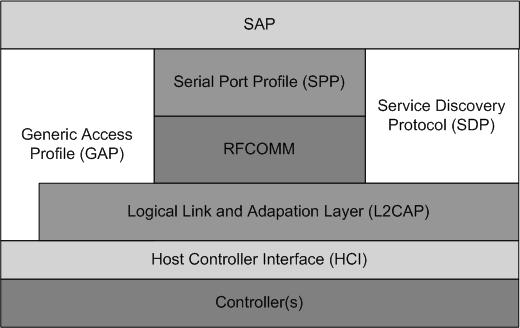
Figure 1.1 below shows the Bluetooth profile structure and the dependencies of the profiles. A profile is dependent upon another profile if it re-uses parts of that profile, by implicitly or explicitly referencing it. Dependency is illustrated in the figure below: a profile has dependencies on the profile(s) in which it is contained directly or indirectly.
 |
1.3. Symbols and Conventions
1.3.1. Requirement Status Symbols
In this document, the following symbols are used:
"M" for mandatory to support (used for capabilities that shall be used in the profile);
"O" for optional to support (used for capabilities that can be used in the profile);
"C" for conditional support (used for capabilities that shall be used in case a certain other capability is supported);
"X" for excluded (used for capabilities that may be supported by the unit but shall never be used in the profile if this is the only active profile);
"N/A" for not applicable (in the given context it is impossible to use this capability).
Some excluded capabilities are capabilities that, according to the relevant Bluetooth specification, are mandatory. These are features that may degrade operation of devices following this profile. Therefore, these features should not be activated while a unit is operating as a unit within this profile.
1.3.2. Signaling Diagram Conventions
The following arrows are used in diagrams describing procedures (see Figure 1.2):

1.3.3. Byte Ordering Convention
When multiple byte fields are contained in this specification, the standard network byte order (Big endian), with more significant (high-order) bytes being transferred before less-significant (low-order) bytes, is used.
2. Profile Overview
2.1. Profile Stack
Figure 2.1 shows the protocols and entities used in this profile.
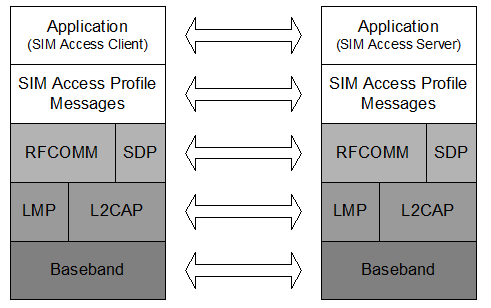 |
The Baseband, LMP and L2CAP are the OSI layer 1 and 2 Bluetooth protocols. RFCOMM is the Bluetooth serial port emulation entity. SDP is the Bluetooth Service Discovery Protocol. See [1] for more details on these topics.
The messages of the SIM Access Profile are defined in this document. It also contains the interoperability guidelines for the applications in the Client and Server.
2.2. Configuration and Roles
Error! Reference source not found. shows the basic system configuration, which is taken as a reference in this profile document:
 |
The following two roles are defined for this profile:
Server - The SIM Access Server has direct (galvanic) access to a subscription module. It acts as a SIM card reader, which assists the Client in accessing and controlling the subscription module via the Bluetooth link.
Client - The SIM Access Client is connected via a Bluetooth link to the SIM Access Server. The Client accesses and controls the subscription module inside the Server via the Bluetooth link.
Typical examples of a Server are a simple SIM card holder or a portable phone in the car environment. A typical example of a Client is a car phone, which uses a subscription module in the Server for a connection to the cellular network.
Both the subscription module and the cellular network play an important role in the SIM Access Profile. However, the presence of either entity is not mandatory during the operation of the profile.
2.3. User Requirements and Scenarios
In general, the SIM Access Server functions as a SIM card reader for the SIM Access Client. The SIM Access Profile enables all scenarios that are also possible with wired SIM card readers.
Two scenarios are depicted here, as they serve as building blocks for other scenarios. Both scenarios will be referenced throughout the document.
2.3.1. Scenario 1: Subscription Module in the Server
As shown in Error! Reference source not found., the Server contains a Subscription Module, which is used by the Client. The Client accesses the files and services of the card subscription module as if the subscription module was directly contained in the Client or connected via a cable. For example, it is possible to
-
register the Client in the cellular network using the subscription information stored in the subscription module.
-
make a call from the Client using the subscription information stored in the subscription module.
-
use the Client to access phonebook data stored in the subscription module[1].
In this scenario, the ME-SIM interface (as specified in [3] and [6]) is extended over the Bluetooth link.
2.3.2. Scenario 2: Proactive SIM in the Client and Additional SIM in the Server
below shows a scenario, in which the Client contains a proactive subscription module. The Client uses this subscription module for connecting to the cellular network.
Furthermore, the proactive subscription module may request the Client to control the additional subscription module, which is located in the Server (see [4], [8] and [11]). For this purpose the SIM Access Profile provides the necessary means to perform all functions that are required by [4], [8] and [11]. For example, it is possible to
-
power the card in the Server on or off,
-
reset the card in the Server or
-
get the status of the card and the card reader (i.e. the Server).
 |
2.4. Profile Fundamentals
The SIM Access Profile describes the messages and procedures for accessing a subscription module over a Bluetooth link. It is especially designed for usage with:
-
GSM SIM cards and provides a transport and remote control solution for GSM 11.11 [3] and GSM 11.14 [4].
-
UICC cards and provides a transport and remote control solution for TS 102.221 [6], TS 31.102 [7] and TS 31.111 [8].
-
R-UIM cards and provides a transport and remote control solution for TIA/EIA/IS-820 [9], TIA/EIA/IS-820-1 [10].
The SIM Access Server contains a subscription module and is responsible for establishing and maintaining the physical connection to the subscription module. The Server also acts as the mediator for all messages (APDUs) exchanged between the SIM Access Client and the subscription module. Furthermore, if the Client requests information from the Server about the subscription module or about the Server itself, the Server shall respond by sending the requested data over the Bluetooth link.
The Client is in most cases a phone, which behaves according to the relevant GSM, 3GPP or 3GPP2 specifications. This behavior is fully supported by the SIM Access Profile, by providing the necessary framework.
The Server might also be a phone, which apart from the SIM Access Profile functionality has the ability to use the subscription module for its own cellular network connection. According to the GSM, 3GPP and 3GPP2 specifications, this is only allowed, if the Server is outside of a SIM Access Profile connection (see Sections 4.1, 4.2 and 4.3 for details).
In general, the Server may establish a SIM Access Profile connection, even if there is no subscription module in the Server. Similarly, the Server may establish a connection, even if its subscription module is powered off. In order to handle these different situations, the Client shall be informed about the status of the subscription module during connection setup (see Sections 4.1 and 4.9).
The application of the profile is limited to one Server, which establishes a SIM Access Profile connection to one Client. Similarly, the Server shall only grant the Client access to a single GSM application, USIM application or an R-UIM application on a subscription module card in the context of this profile.
The Client initiates the connection to the Server and performs device discovery and paging. The Server therefore shall be discoverable and connectable according to the Generic Access Profile. See Section 8 for details.
2.5. Bluetooth Security
In order to ensure secure communication between Client and Server, several security measures from the Bluetooth specification are mandatory.
Bonding - Client and Server shall be bonded before setting up a SIM Access Profile connection. Security mode 2 or 3 is required for devices implementing the Bluetooth 2.0+EDR, or earlier, specification. Security mode 4 is required for devices implementing the Bluetooth 2.1+EDR, or later, specification. Details are given in Section 8.2.
Encryption - The link between Client and Server shall be encrypted using Bluetooth baseband encryption.
Server Initiated Authentication - The SIM Access Server shall always initiate the authentication procedure.
Link Keys – Only standard combination keys or authenticated combination keys shall be used for SIM Access Profile connections. This means that the ‘just works’ association model shall not be used with SAP as it results in an unauthenticated combination key and does not protect against man-in-the middle attacks. An implementation (client or server) shall support combination keys being changed at each new SIM Access Profile connection. An implementation should change the combination keys at each new SIM Access Profile connection. For increased security, this is encouraged..
Encryption Key Length - A SAP-enabled device shall support the maximum length encryption key as given in the Bluetooth specification. A connected pair of devices may use an encryption key smaller than the specification maximum when required by the laws of the country where the devices are being used, with the restriction that the length of the encryption key shall be at least 64 bits. For increased security, use of the maximum length is suggested.
PIN - When standard combination keys are used, the PIN shall have the length of 16 digits. Additionally, it is strongly recommended that the PIN satisfies the complexity requirements described in [12]. Fixed PINs shall not be used. When authenticated combination keys are used either a passkey or numerical comparison value shall be used depending on the I/O capabilities of the two devices. The length of this passkey or numerical comparison value shall be six digits. The Authentication_Requirements parameter shall be set to MITM Protection Required.
2.6. Conformance
If conformance to this profile is claimed, all capabilities indicated mandatory for this profile shall be supported in the specified manner (process mandatory). This also applies for all optional and conditional capabilities for which support is indicated. All mandatory capabilities, and optional and conditional capabilities for which support is indicated, are subject to verification as part of the Bluetooth qualification program.
3. Application Layer Features
Table 3.1 shows the feature requirements made by this profile.
|
Item no. |
Feature |
Support in Client |
Support in Server |
|---|---|---|---|
|
1 |
Connection Management |
M |
M |
|
2 |
Transfer APDU |
M |
M |
|
3 |
Transfer ATR |
M |
M |
|
4 |
Power SIM off |
O |
M |
|
5 |
Power SIM on |
M |
M |
|
6 |
Reset SIM |
O |
M |
|
7 |
Report Status |
M |
M |
|
8 |
Transfer Card Reader Status |
O |
M |
|
9 |
Error Handling |
M |
M |
|
10 |
Set Transport Protocol |
O |
O |
The features are defined in the following subclauses.
3.1. Feature Definitions
Connection Management - The ability to establish and terminate a SIM Access Profile connection between Client and Server.
An established SIM Access Profile connection is the prerequisite for all other features.
Transfer APDU - The ability to send APDUs (Application Protocol Data Units) over the Bluetooth link in both directions.
APDUs sent to the subscription module are called Command APDUs, while APDUs sent by the subscription module are called Response APDUs. Command APDUs and Response APDUs only occur as pairs, where each Command APDU is followed by a Response APDU. The APDU exchange shall always be initiated by the Client.
The format and content of the APDUs are defined in [3], [4] for CommandAPDU parameter, and in [12] for CommandAPDU7816 parameter (see section 5.2.6).
Transfer ATR - The ability to send the content of the ATR (Answer to Reset) from the Server to the Client over the Bluetooth link.
The ATR shall be sent by the subscription module to the Server after the subscription module has been powered on or reset. It contains information about the interface provided by the subscription module and the services on the GSM SIM, the UICC or the R-UIM.
The format and content of the ATR are defined in [2].
Power SIM Off - The ability to power the subscription module off remotely.
This feature gives the Client a means to power the subscription module in Server off remotely. It is needed for the Application Toolkit[2] purposes as shown in Scenario 2 (Section 2.3.2).
Power SIM On - The ability to power the subscription module on remotely.
This feature gives the Client a means to power the subscription module in the Server on remotely. It is e.g. needed for Application Toolkit[2] purposes as shown in Scenario 2 (Section 2.3.2).
Reset SIM - The ability to reset the SIM remotely.
This feature gives the Client a means to reset the subscription module in the Server. It is e.g. needed for Application Toolkit[2], as shown in Scenario 2 (Section 2.3.2).
Report Status - The Server's ability to inform the Client about the status of the physical connection between the Server and the subscription module.
This feature enables the Client to react appropriately, if the subscription module is e.g. removed or inserted in the Server.
Transfer Card Reader Status - The ability to send the Card Reader Status from the Server to the Client over the Bluetooth link.
The card reader status contains some basic information about the Card Reader and the subscription module (e.g. the size of the SIM or if the SIM is removable). This information is required for Application Toolkit1 purposes as shown in Scenario 2 (Section 2.3.2) and specified in [4], [8] and [11].
Error Handling - The ability to handle invalid formatted messages.
If the Server receives an invalid formatted message from the Client, the Server shall send an appropriate error message (see section 5.3).
Set Transport Protocol - The client’s ability to request the use of another Transport Protocol than T=0 from the server.
The server shall reset the subscription module and switch to the desired protocol if supported by subscription module and Server.
The features "Power SIM off" and "Transfer Reader Status" are only applicable for Scenario 2 (Section 2.3.2). All other features are applicable for both Scenarios.
4. Procedures
This chapter describes the procedures for all features listed in the previous chapter. Each procedure consists of one or more messages that are exchanged between the SIM Access Client and Server.
Table 4.1 maps each feature to the procedures used for that feature. It is mandatory to implement a procedure, if the respective feature is supported by the device.
|
Item no. |
Feature |
Procedure |
Ref. |
|---|---|---|---|
|
1 |
Connection Management |
Connect Report Status Transfer ATR Disconnect Initiated by the Client Disconnect Initiated by the Server |
|
|
2 |
Transfer APDU |
Transfer APDU |
|
|
3 |
Transfer ATR |
Transfer ATR |
|
|
4 |
Power SIM off |
Power SIM off |
|
|
5 |
Power SIM on |
Power SIM on Transfer ATR |
|
|
6 |
Reset SIM |
Reset SIM Transfer ATR |
|
|
7 |
Report Status |
Report Status |
|
|
8 |
Transfer Card Reader Status |
Transfer Card Reader Status |
|
|
9 |
Error Handling |
Error Response |
|
|
10 |
Set Transport Protocol |
Set Transport Protocol |
4.1. Connect
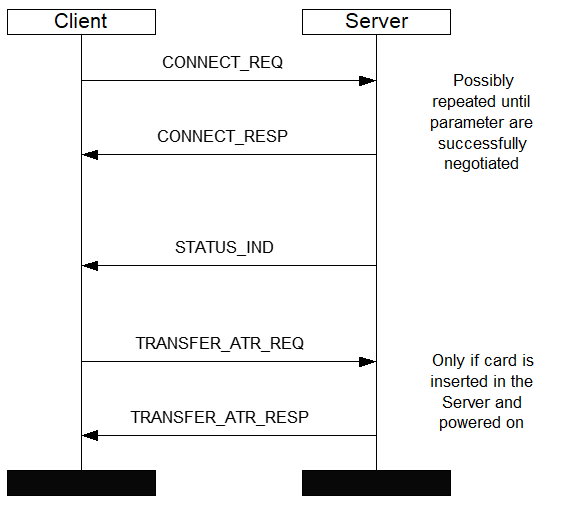
In order to start the SIM Access Profile connection and negotiate important parameters adherent to the connection, the messages CONNECT_REQ, CONNECT_RESP, STATUS_IND, TRANSFER_ATR_REQ and TRANSFER_ATR_RESP are used as described below.
Before the Client may send a SIM Access Profile message to the Server, the two devices must have established an L2CAP and RFCOMM connection (see also Section 7).
After the RFCOMM connection is established, the Client may issue a CONNECT_REQ message to the Server. The Server shall answer with the CONNECT_RESP message[3]. These two messages may be repeated as described in Section 4.11 in order to negotiate the maximum message size to be deployed in the SIM Access Profile connection.
Note: The term ‘ongoing calls’ includes both fully established and set-up-in-progress calls.
If the Server contains a subscription module that is currently powered on, the Server shall ensure that the subscription module is in a well-defined state. This shall be done without affecting ongoing calls on the server device. The T=0 transport protocol shall be internally used by the server. To change the transport protocol, the feature ‘Set Transport Protocol’ shall be used.
After the Server has sent the CONNECT_RESP message with the parameter "ConnectionStatus" set to "OK, Server can fulfil requirements" (see Section 5.3.2), it shall inform the Client about the status of its subscription module connection by sending the STATUS_IND message (see Section 4.9 for details).
If the message size negotiation succeeds, but the server cannot reset the SIM due to an ongoing call, the server shall send the CONNECT_RESP with the parameter "OK, ongoing call”. The server shall reset the SIM card and send the STATUS_IND (“Card reset”) message as soon as the ongoing call has been released.
If a subscription module is inserted in the Server and powered on (i.e. STATUS_IND message contains the parameter "Card reset"), the Client shall request the ATR of the subscription module with the TRANSFER_ATR_REQ message. If the T=0 protocol is not supported (i.e. STATUS_IND message contains the parameter "Card_not_accessible"), the Client may request the ATR of the subscription module with the TRANSFER_ATR_REQ message to retrieve information about protocols supported by the subscription module and use the Set Transport Protocol feature subsequently. In both cases the Server shall answer with the TRANSFER_ATR_RESP message as described in Section 4.5.
Figure 4.1 illustrates how the Client and Server connect successfully:
 |
The successful performance of the connection setup procedure is a precondition for all of the following procedures.
If the Server is unable to connect to the Client, it indicates this in the CONNECT_RESP message with the parameter "ConnectionStatus" set to "Error, Server unable to establish connection" (see Section 5.3.2). In this case, the SIM Access Profile connection between Client and Server is not established.
4.1.1. Negotiation of Profile Parameter
The CONNECT_REQ and CONNECT_RESP messages are also used to negotiate the maximum message size (parameter MaxMsgSize, see 5.3.1), that will be deployed in the SIM Access Profile connection.
First, the Client sends its MaxMsgSize value to the Server. If the Server supports this value, it shall set the parameter ConnectionStatus (see 5.3.2) in the CONNECT_RESP message to "OK, Server can fulfill requirements". If not, it shall set the ConnectionStatus to "Error, Server does not support message size" and includes its MaxMsgSize (i.e. a smaller value) in the CONNECT_RESP message.
In the latter case, it is up to the Client, if it sends another CONNECT_REQ message. This message shall then include the MaxMsgSize value proposed by the Server.
If the Client proposes a MaxMsgSize value, which the Server regards as too small, the Server shall set the "ConnectionStatus" parameter to "Error, maximum message size by Client is too small". In this case, the SIM Access Profile connection between the Client and the Server shall not be established.
4.2. Disconnect Initiated by the Client
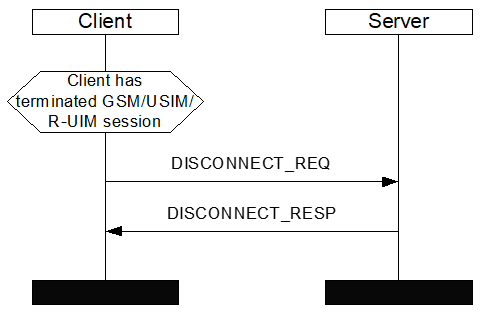
If the Client wants to release the SIM Access Profile connection, it first shall terminate any existing GSM application session, USIM application session or R-UIM application session which involves the subscription module in the Server. The Client shall then send a DISCONNECT_REQ message to the Server.
The Server shall answer with a DISCONNECT_RESP message and the SIM Access Profile is successfully released.
After the disconnection of a SIM Access Profile connection, the Client shall immediately disconnect the corresponding RFCOMM data channel between the Client and the Server.
Note: After sending the DISCONNECT_RESP message, the Server may use the subscription module for another SIM Access Profile connection or for its own cellular network connection.
Figure 4.2 illustrates how the Client initiates a disconnect from the Server:
 |
4.3. Disconnect Initiated by the Server
If the Server wants to release the SIM Access Profile connection, it shall send the DISCONNECT_IND message to the Client. Within this message the Server shall indicate, if it wants to release the SIM Access Profile connection immediately or gracefully.
If the Server requests an immediate release, no more messages shall be exchanged and the SIM Access Profile connection shall be released directly after the DISCONNECT_IND message. Furthermore, the Client immediately shall terminate any existing GSM application session, USIM application session or R-UIM application session in order to be compliant to the relevant GSM specifications, 3GPP specifications and 3GPP2 specifications. In this case the RFCOMM channel between the Client and the Server shall be immediately disconnected by the Server.
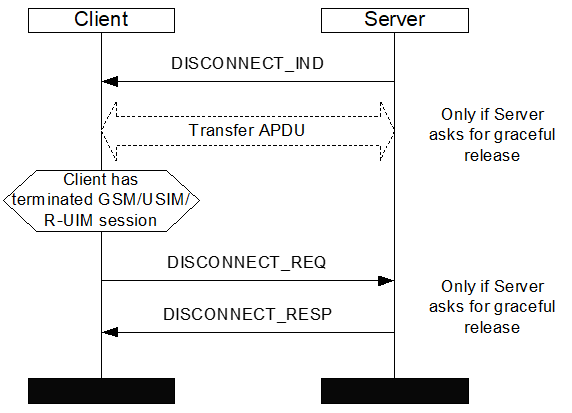
If the Server requests a graceful connection shutdown, a transfer of APDUs may occur before the Client terminates any existing GSM application session, USIM application session or R-UIM application session and sends the DISCONNECT_REQ message. Finally, the Server shall send a DISCONNECT_RESP message and the SIM Access Profile connection shall be released. Similar to the case of disconnect initiated by the Client, in case of graceful disconnection initiated by the Server the Client shall immediately disconnect the corresponding RFCOMM data channel between the Client and the Server.
If after graceful connection shutdown request from the Server certain amount of time (transmitted APDUs) elapsed and no DISCONNECT_REQ message was received from the Client, the Server may initiate an immediate disconnection by sending the DISCONNECT_IND message with DisconnectionType parameter set to immediate.
Figure 4.3 illustrates how the Server initiates a graceful disconnect from the Client. If an immediate disconnect is desired, the server shall send the DISCONNECT_IND message and end the connection.
 |
4.4. Transfer APDU
To transfer an APDU between the Client and the Server, the messages TRANSFER_APDU_ REQ and TRANSFER_APDU _RESP shall be used. ADPU transfers shall be initiated by the Client only.
Both messages contain an APDU (as defined for the GSM application in GSM 11.11 or GSM 11.14 and as defined in ISO/IEC 7816-4 for all other applications) in their payload. The message APDU_TRANSFER_REQ shall be used for Command-APDUs (from Client to the subscription module). The message TRANSFER_APDU_RESP shall be used for Response-APDUs (from the subscription module to the Client).
Figure 4.4 illustrates the successful exchange of APDUs between Client and Server:
 |
If no error has occurred, the TRANSFER_APDU_RESP message shall contain the result code "OK, request processed correctly" (see Section 5.3.4). In case of an error, the TRANSFER_APDU_RESP message shall contain an appropriate result code (see also Section 5.3.4):
-
If the card is removed from the Server, the result code "Error, card removed" shall be used.
-
If the card is inserted in the Server but powered off, the result code "Error, card (already) powered off" shall be used.
-
If the Server detects, that the card does not answer, the result code "Error, card not accessible" shall be used.
Please note, that this is independent of the case, in which the Client detects, that the subscription module is not responding to e. g. Command APDUs.
-
If an error has occurred, which cannot adequately be described by any of the previous reasons, the result code "Error, no reason defined" shall be used.
4.5. Transfer ATR
The Client may request the Server to send the ATR from the subscription module. The TRANSFER_ATR_REQ message shall be used for this purpose. Following this request, the Server shall send the ATR to the Client in the payload of the TRANSFER_ATR_RESP message.
Figure 4.5 illustrates the successful ATR transfer:
 |
If no error has occurred, the TRANSFER_ATR_RESP message shall contain the result code "OK, request processed correctly" (see Section 5.3.4). In case of an error, the TRANSFER_APDU_RESP message shall contain an appropriate result code (see also Section 5.3.4):
-
If the card is inserted in the Server but powered off, the result code "Error, card (already) powered off" shall be used.
-
If the card is removed from the Server, the result code "Error, card removed" shall be used.
-
If the Server cannot send the ATR for any other reason, the result code "Error, data not available" shall be used.
If an error has occurred, which cannot adequately be described by any of the previous reasons, the result code "Error, no reason defined" shall be used.
4.6. Power SIM Off
If the Client wants the Server to power off the subscription module, it first shall terminate any existing GSM application session, USIM application session or R-UIM application session which involves the subscription module in the Server.
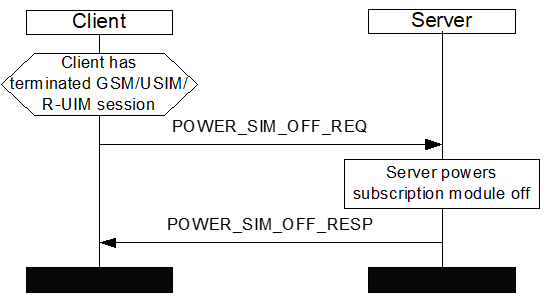
The Client may then send the POWER_SIM_OFF_REQ message to the Server. Upon receiving this message, the Server shall power off the subscription module, i. e. it removes the voltage from the card. Afterwards, the Server shall send the POWER_SIM_OFF_RESP message to the Client.
Figure 4.6 illustrates the successful case when the Client requests the Server to power off the subscription module:
 |
If no error has occurred, the POWER_SIM_OFF_RESP message shall contain the result code "OK, request processed correctly" (see Section 5.3.4).
In case of an error, the POWER_SIM_OFF_RESP message shall contain an appropriate result code (see also Section 5.3.4):
-
If the card is already powered off, the result code "Error, card (already) powered off" shall be used.
-
If the card is removed from the Server, the result code "Error, card removed" shall be used.
If an error has occurred, which cannot adequately be described by any of the previous reasons, the result code "Error, no reason defined" shall be used.
4.7. Power SIM On
If a subscription module is powered off, the Client may request the Server to power it on again, i. e. to apply the supply voltage and clock signal to the subscription module. The POWER_SIM_ON_REQ message shall be used for this purpose.
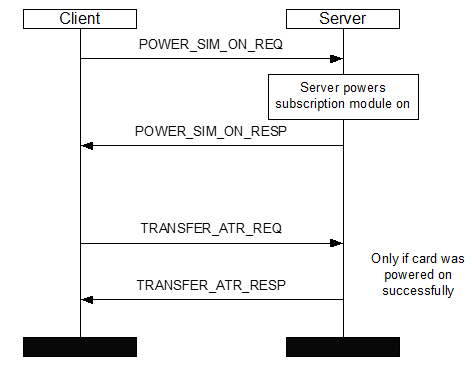
Upon receiving this message, the Server powers the subscription module on. The transport protocol which shall be internally used by the server is T=0. To change the transport protocol, the feature ‘Set Transport Protocol’ shall be used. After this has been completed, the Server shall send the POWER_SIM_ON_RESP message to the Client.
If the POWER_SIM_ON_RESP message indicates that the subscription module was powered on successfully (see below), the Client shall request the ATR of the subscription module with the TRANSFER_ATR_REQ message. If the POWER_SIM_ON_RESP message indicates that the SIM doesn’t support the T=0 protocol (see below), the Client may request the ATR of the subscription module with the TRANSFER_ATR_REQ message to retrieve information about the subscription module. In both cases the Server shall answer with the TRANSFER_ATR_RESP message as described in Section 4.5.
Figure 4.7: illustrates the successful case when the Client requests the Server to power on the subscription module:
 |
If no error has occurred, the POWER_SIM_ON_RESP message shall contain the result code "OK, request processed correctly" (see Section 5.3.4).
In case of an error, the POWER_SIM_ON_RESP message shall contain an appropriate result code (see also Section 5.3.4):
-
If the card is removed from the Server, the result code "Error, card removed" shall be used.
-
If the card is inserted in the Server but either cannot be powered on or the T=0 protocol is not supported, the result code "Error, card not accessible" shall be used.
-
If the card is inserted in the Server but already powered on, the result code "Error, card (already) powered on" shall be used. In this case, the Server shall neither reset nor power on the card again.
-
If an error has occurred, which cannot adequately be described by any of the previous reasons, the result code "Error, no reason defined" shall be used.
4.8. Reset SIM
If the Client wants the Server to reset the subscription module, it first shall terminate any existing GSM application session, USIM application session or R-UIM application session, which involves the subscription module in the Server.
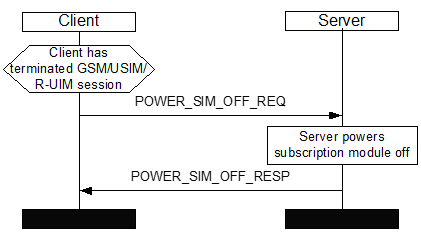
The Client may then send the RESET_SIM_REQ message to the Server. Upon receiving this message, the Server shall reset the subscription module. The transport protocol which shall be internally used by the server is T=0. To change the transport protocol, the feature ‘Set Transport Protocol’ shall be used. After this has been completed, the Server shall send the RESET_SIM_RESP message to the Client.
If the RESET_SIM_RESP message indicates that the subscription module was reset successfully (see below), the Client shall request the ATR of the subscription module with the TRANSFER_ATR_REQ message. If the RESET_SIM_RESP message indicates that the subscription module doesn’t support the T=0 protocol (see below), the Client may request the ATR of the subscription module with the TRANSFER_ATR_REQ message to retrieve information about the subscription module. In both cases the Server shall answer with the TRANSFER_ATR_RESP message as described in Section 4.5.
Figure 4.8 illustrates the successful case when the Client requests the Server to reset the subscription module:
 |
If no error has occurred, the RESET_SIM_RESP message shall contain the result code "OK, request processed correctly" (see Section 5.3.4).
In case of an error, the RESET_SIM_RESP message shall contain an appropriate result code (see also Section 5.3.4):
-
If the card is removed from the Server, the result code "Error, card removed" shall be used.
-
If the card is inserted in the Server but either cannot be reset or the T=0 protocol is not supported, the result code "Error, card not accessible" shall be used.
-
If the card is inserted in the Server and powered off, the result code "Error, card (already) powered off" shall be used. In this case, the Server shall not perform any actions, e. g. powering on the card.
If an error has occurred, which cannot adequately be described by any of the previous reasons, the result code "Error, no reason defined" shall be used.
4.9. Report Status
This procedure is deployed during the connection setup phase (see Section 4.1) or whenever a change in the physical connection between Server and SIM occurs. The STATUS_IND message is used to inform the Client about the status or the status change.
During the connection setup phase (see Section 4.1) three alternatives are possible:
-
A subscription module is inserted in the Server and has been powered on or reset prior to the SIM Access Profile connection or after releasing an ongoing phone call. In this case, the STATUS_IND message has the parameter "Card_reset".
-
A subscription module is inserted in the Server, but cannot be powered on, is not accessible, or doesn’t support the default T=0 protocol. In this case, the STATUS_IND message has the parameter "Card_not_accessible".
-
No subscription module is inserted in the Server. In this case, the STATUS_IND message has the parameter "Card_removed".
During an ongoing connection, the following changes in the subscription module status can occur:
-
The subscription module is removed from the Server. In this case, the STATUS_IND message with the parameter "Card_removed" shall be sent.
-
A subscription module is inserted in the Server. In this case, the STATUS_IND message with the parameter "Card_inserted" shall be sent. If the Client wants to take the subscription module into use, it has to power it on.
-
While the subscription module remains inserted in the Server, the physical contact between Server and the subscription module can be lost. In this case, the message STATUS_IND with the parameter "Card_not_accessible" shall be sent.
-
If a non-accessible card can be made accessible again, the Server shall power the card on. After that, the Server shall send the STATUS_IND message with the parameter “Card_recovered”.
All of the above cases are independent from those cases, in which the Client detects, that the subscription module is not responding to e. g. Command APDUs. In any case, the behavior of the Client shall be inline with the GSM specifications 3GPP specifications and 3GPP2 specifications [3], [4], [6], [7], [8], [9], [10], [11].
Figure 4.9 illustrates the case when the Server detects a change in the physical connection to the card:
 |
Please note, that the STATUS_IND message shall not be used in conjunction with a status change due to a POWER_SIM_OFF_REQ, POWER_SIM_ON_REQ or RESET_SIM_REQ message.
4.10. Transfer Card Reader Status
The Client may ask the Server to return the Card Reader Status using the TRANSFER_CARD_READER_STATUS_REQ message. Following this request, the Server shall send the Client the Card Reader Status in the TRANSFER_CARD_READER_STATUS_RESP message.
Figure 4.10 shows the allowed signaling flow when the Client requests the Card Reader Status from the Server:
 |
If no error has occurred, the TRANSFER_CARD_READER_STATUS_RESP message shall contain the result code "OK, request processed correctly" (see Section 5.3.4). In case of an error, the TRANSFER_CARD_READER_STATUS_RESP message shall contain an appropriate result code (see also Section 5.3.4):
If the Server cannot send the Card Reader Status for any other reason, the result code "Error, data not available" shall be used.
If any other error has occurred, the result code "Error, no reason defined" shall be used.
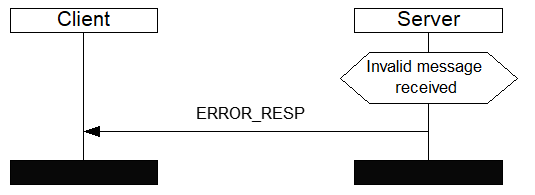
4.11. Error Response
The Server shall send an Error Response message ERROR_RESP to the Client whenever it has received a request message from the Client, which was invalid or improperly formatted (see Figure 4.11).
The Client may close the SIM Access Profile Connection after it has received an ERROR_RESP message from the Server.
 |
In all cases, where an error occurred while processing a valid and properly formatted request, the error shall be indicated in the respective response message (e.g. TRANSFER_APDU_RESP).
4.12. Set Transport Protocol
If the server supports the T=0 protocol, it shall be used as a default protocol (see sections 4.1, 4.7, 4.8). If the server or the subscription module do not support T=0, then the initial STATUS_IND after the CONNECT_RESP shall contain the status “Card not accessible”. The mechanisms described in this chapter shall then be used to select an appropriate protocol.
The client may change the transport protocol, by first terminating any existing GSM application session, USIM application session or R-UIM application session, which involves the subscription module in the Server.
The client shall then send the SET_TRANSPORT_PROTOCOL_REQ with a parameter that specifies the transport protocol which the client wants to use.
If the command is supported by the server, the server shall respond with SET_TRANSPORT_PROTOCOL_RESP and status “OK, request processed correctly”. The server shall then internally perform a reset of the subscription module and issue a STATUS_IND with the status “Card reset”. The client shall then continue with TRANSFER_ATR_REQ.
If the command is supported by the server, but the subscription module does not support the selected transport protocol, the status of the STATUS_IND shall be “Card not accessible”. The client may then send the TRANSFER_ATR_REQ to retrieve information about the subscription module.
If the command is supported by the server, but the required transport protocol is not supported by the server, the server shall respond with the error code “Error, not supported” in the SET_TRANSPORT_PROTOCOL_RESP. Before the subscription module can be accessed again, another SET_TRANSPORT_PROTOCOL_REQ is needed.
If the server does not support the command, it shall respond with ERROR_RESP as described in section 4.11.
 |
4.12. State Machine
Figure 4.13 shows the simplified state machine underlying the SIM Access Profile. The three main states are "Not connected", "Connection under negotiation" and "Connected". Within the "Connected" state, several sub-states exist.

As it can be seen from the state machine, each request message (e. g. TRANSFER_APDU_REQ) can in general only be followed by the corresponding response message (TRANSFER_APDU_RESP). However, there are two exceptions. The POWER_SIM_OFF_REQ and RESET_SIM_REQ can be sent in nearly any state, in order to allow the Client to reactivate a not accessible subscription module card.
For simplicity reasons, the messages DISCONNECT_REQ, DISCONNECT_IND, DISCONNECT_RESP, STATUS_IND and ERROR_RESP are not included in the figure. The usage of these messages is as follows:
-
The DISCONNECT_REQ, DISCONNECT_IND (and DISCONNECT_RESP) messages may be sent in any of the sub-states of the "Connected" state. After Client and Server have disconnected as described in Sections 4.2 and 4.3, the new state is "Not connected".
-
The STATUS_IND message may be sent in any of the sub-states of the "Connected" state. After that, the new state is "Idle".
-
The ERROR_RESP message replaces - when necessary - any other response message. If the previous state was "Connection under negotiation", the new state is "Not connected". In all other cases, the new state is "Idle".
4.13. Bluetooth Link Loss
The Server or the Client can detect a Bluetooth link loss. Whenever either device detects a Bluetooth link loss, the SIM Access Profile connection shall be terminated by that device.
5. Message and Parameters
This chapter describes the coding and formats of the messages and parameters of the SIM Access Profile. The SIM Access Profile messages are transported on an RFCOMM link.
5.1. Message Formats
Messages are formatted as shown in Figure 5.1 (length of each field is given in bytes):
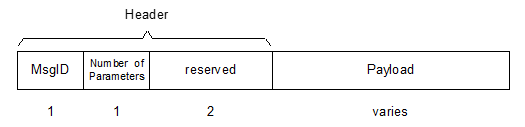
The message header consists of three fields. The field "MsgID" contains the message ID as given in Section 5.2. The field "Number of Parameters" gives the number of parameters in the payload of the message.
Two bytes are reserved for future use and shall be set to 0x0000 until otherwise specified in future revisions of the SIM Access Profile.
The payload itself contains the parameters as listed in the following Sections. Each Parameter is formatted as shown in Figure 5.2 using three fields:

The fields "Parameter ID", "Parameter Length", "Parameter Value", the reserved field and the "Padding Bytes" are repeated for each parameter. The ordering of the parameters shall be as listed in the tables in Section 5.2.
The reserved field and the padding bytes shall be set to 0x00 until otherwise specified in future revisions of the SIM Access Profile.
The "Parameter ID" shall contain the ID of the parameter as listed in Section 5.3. The "Parameter Length" field gives the length of the "Parameter Value" (see Section 5.3).
The length of each Parameter shall be a multiple of four bytes. Therefore, one to three additional bytes have to be added directly after the "Parameter Value".
5.2. Message Coding
This section defines the allowed messages in the SIM Access Profile. It is mandatory to implement a message, if the respective procedure is supported by the device.
|
Message |
Direction |
Msg ID |
|---|---|---|
|
CONNECT_REQ CONNECT_RESP |
Client -> Server Server -> Client |
0x00 0x01 |
|
DISCONNECT_REQ DISCONNECT_RESP DISCONNECT_IND |
Client -> Server Server -> Client Server -> Client |
0x02 0x03 0x04 |
|
TRANSFER_APDU_REQ TRANSFER_APDU_RESP |
Client -> Server Server -> Client |
0x05 0x06 |
|
TRANSFER_ATR_REQ TRANSFER_ATR_RESP |
Client -> Server Server -> Client |
0x07 0x08 |
|
POWER_SIM_OFF_REQ POWER_SIM_OFF_RESP |
Client -> Server Server -> Client |
0x09 0x0A |
|
POWER_SIM_ON_REQ POWER_SIM_ON_RESP |
Client -> Server Server -> Client |
0x0B 0x0C |
|
RESET_SIM_REQ RESET_SIM_RESP |
Client -> Server Server -> Client |
0x0D 0x0E |
|
TRANSFER_CARD_READER_STATUS_REQ TRANSFER_CARD_READER_STATUS_RESP |
Client -> Server Server -> Client |
0x0F 0x10 |
|
STATUS_IND ERROR_RESP |
Server -> Client Server -> Client |
0x11 0x12 |
|
SET_TRANSPORT_PROTOCOL_REQ SET_TRANSPORT_PROTOCOL_RESP |
Client -> Server Server -> Client |
0x13 0x14 |
5.2.1. CONNECT_REQ
The CONNECT_REQ message contains the following parameter:
|
Parameter |
Ref. |
Status |
|---|---|---|
|
MaxMsgSize |
M |
The parameter MaxMsgSize shall be used by the Client and Server to negotiate the value that is to be used for the SIM Access Profile connection (see Section 4.1.1).
5.2.2. CONNECT_RESP
The CONNECT_RESP message contains the following parameters:
The parameter ConnectionStatus shall indicate, if the Server can fulfill the capability proposed by the Client. It shall also indicate, if the Server is unable to connect to the Client.
If the Server cannot fulfill the requested capability, the parameter MaxMsgSize shall contain the value that is supported by the Server. Details are described in Section 4.1.1.
5.2.3. DISCONNECT_REQ
The DISCONNECT_REQ message contains no parameter.
5.2.4. DISCONNECT_RESP
The DISCONNECT_RESP message contains no parameter.
5.2.5. DISCONNECT_IND
The DISCONNECT_IND message contains the following parameter:
|
Parameter |
Ref. |
Status |
|---|---|---|
|
DisconnectionType |
M |
The Disconnect Type shall indicate if the Server wants to shutdown the SIM Access Profile connection gracefully or immediately.
5.2.6. TRANSFER_APDU_REQ
The TRANSFER_APDU_REQ message contains the following parameters:
- C1:
-
The TRANSFER_APDU_REQ message shall always contain exactly one of the CommandAPDU or the CommandAPDU7816 parameters.
If the device implementing the SAP server is GSM-capable, the support of the CommandAPDU parameter is mandatory for the server, otherwise optional. If the client implements the GSM application, the support of the CommandAPDU parameter is mandatory for the client, otherwise optional.
The support of the CommandAPDU7816 parameter is optional for the client[4] and is mandatory for the server.
5.2.7. TRANSFER_APDU_RESP
The TRANSFER_APDU_RESP message contains the following parameters:
The parameter ResultCode shall indicate, if the Command APDU was processed correctly. Any error response from the subscription module interface to the Server is mapped onto this field.
The parameter ResponseAPDU shall be included only if the Command APDU was processed correctly and no other error occurred.
5.2.8. TRANSFER_ATR_REQ
The TRANSFER_ATR_REQ message contains no parameter.
5.2.9. TRANSFER_ATR_RESP
The TRANSFER_ATR_RESP message contains the following parameters:
The parameter ResultCode includes possible error codes.
The parameter ATR includes the Answer to Reset from the subscription module. It shall be included only if no error has occurred.
5.2.10. POWER_SIM_OFF_REQ
The POWER_SIM_OFF_REQ message contains no parameter.
5.2.11. POWER_SIM_OFF_RESP
The POWER_SIM_OFF_RESP message contains the following parameter:
|
Parameter |
Ref. |
Status |
|---|---|---|
|
ResultCode |
M |
The parameter ResultCode includes possible error codes.
5.2.12. POWER_SIM_ON_REQ
The POWER_SIM_ON_REQ message contains no parameter.
5.2.13. POWER_SIM_ON_RESP
The POWER_SIM_ON_RESP message contains the following parameter:
|
Parameter |
Ref. |
Status |
|---|---|---|
|
ResultCode |
M |
The parameter ResultCode includes possible error codes and shall indicate, if the subscription module was powered on successfully.
5.2.14. RESET_SIM_REQ
The RESET_SIM_REQ message contains no parameter.
5.2.15. RESET_SIM_RESP
The RESET_SIM_RESP message contains the following parameter:
|
Parameter |
Ref. |
Status |
|---|---|---|
|
ResultCode |
M |
The parameter ResultCode includes possible error codes and shall indicate, if the subscription module was successfully reset.
5.2.16. STATUS_IND
The message STATUS_IND shall be used to indicate (a change in) the availability of the subscription module. The STATUS_IND message contains the following parameter:
|
Parameter |
Ref. |
Status |
|---|---|---|
|
StatusChange |
M |
The parameter StatusChange shall include the reason for the status change.
5.2.17. TRANSFER_CARD_READER_STATUS_REQ
The TRANSFER_CARD_READER_STATUS_REQ message contains no parameter.
5.2.18. TRANSFER_CARD_READER_STATUS_RESP
The TRANSFER_CARD_READER_STATUS_RESP message contains the following parameters:
The parameter ResultCode includes possible error codes.
The parameter CardReaderStatus includes the Card Reader Status as described in GSM 11.14, Section 12.33 and TS 31.111, Section 8.33. It shall be included only if no error has occurred.
5.2.19. ERROR_RESP
The ERROR_RESP message contains no parameter.
5.2.20. SET_TRANSPORT_PROTOCOL_REQ
The SET_TRANSPORT_PROTOCOL_REQ message contains the following parameter:
|
Parameter |
Ref. |
Status |
|---|---|---|
|
Transport Protocol |
M |
5.2.21. SET_TRANSPORT_PROTOCOL_RESP
The SET_TRANSPORT_PROTOCOL_RESP message contains the following parameter:
|
Parameter |
Ref. |
Status |
|---|---|---|
|
ResultCode |
M |
5.3. Parameter IDs and Coding
The following table lists all parameters used in the messages of the SIM Access Profile, their length (in Bytes) and Parameter ID.
|
Parameter |
Length |
Parameter ID |
|---|---|---|
|
MaxMsgSize ConnectionStatus ResultCode DisconnectionType CommandAPDU CommandAPDU7816 ResponseAPDU ATR CardReaderStatus StatusChange Transport Protocol |
2 1 1 1 Varies Varies Varies Varies 1 1 1 |
0x00 0x01 0x02 0x03 0x04 0x10 0x05 0x06 0x07 0x08 0x09 |
5.3.1. MaxMsgSize
The parameter MaxMsgSize consists of two bytes and is coded as an unsigned integer.
5.3.2. ConnectionStatus
The parameter ConnectionStatus is a one byte field. The values are as given in the following table:
|
Possible values for ConnectionStatus |
Value |
|---|---|
|
OK, Server can fulfill requirements |
0x00 |
|
Error, Server unable to establish connection |
0x01 |
|
Error, Server does not support maximum message size |
0x02 |
|
Error, maximum message size by Client is too small |
0x03 |
|
OK, ongoing call |
0x04 |
|
Reserved |
All others |
5.3.3. DisconnectionType
The parameter DisconnectionType is a one byte field. The values are as given in the following table:
|
Possible values for DisconnectionType |
Value |
|---|---|
|
Graceful |
0x00 |
|
Immediate |
0x01 |
|
Reserved |
All others |
"Graceful" shall be used if a graceful disconnect shall be performed while "Immediate" shall be used in case of an immediate disconnect.
5.3.4. ResultCode
The parameter ResultCode is a one byte field. The values are as given in the following table, which also lists the messages, for that a ResultCode value is applicable:
|
Possible values for ResultCode |
Value |
Used in |
||||||
|---|---|---|---|---|---|---|---|---|
|
TRANSFER_APDU_RESP |
TRANSFER_ATR_RESP |
POWER_SIM_OFF_RESP |
POWER_SIM_ON_RESP |
RESET_SIM_RESP |
TRANSFER_CARD_ READER_STATUS_RESP |
SET_TRANSPORT PROTOCOL_RESP |
||
|
OK, request processed correctly |
0x00 |
M |
M |
M |
M |
M |
M |
M |
|
Error, no reason defined |
0x01 |
M |
M |
M |
M |
M |
M |
|
|
Error, card not accessible |
0x02 |
M |
M |
M |
||||
|
Error, card (already) powered off |
0x03 |
M |
M |
M |
M |
|||
|
Error, card removed |
0x04 |
M |
M |
M |
M |
M |
||
|
Error, card already powered on |
0x05 |
M |
||||||
|
Error, data not available |
0x06 |
M |
M |
|||||
|
Error, not supported |
0x07 |
M |
||||||
|
Reserved |
All others |
|||||||
5.3.5. CommandAPDU, CommandAPDU7816 and ResponseAPDU
The parameter CommandAPDU contains a C-APDU that shall be coded in accordance with the GSM 11.11 specification. The parameter CommandAPDU7816 contains a C‑APDU that shall be coded in accordance with ISO/IEC 7816-4 specification.
The parameter ResponseAPDU contains an R-APDU that shall be coded in accordance with either the GSM 11.11 or the ISO/IEC 7816-4 specifications, depending on whether it is contained in the TRANSFER_APDU_RESP message responding to the TRANSFER_APDU_REQ message containing the CommandAPDU or the CommandAPDU7816 parameter.
5.3.6. ATR
The parameter ATR shall contain an ATR that is coded as described in the ISO/IEC 7816-3 specification.
5.3.7. CardReaderStatus
The parameter CardReaderStatus shall contain the Card Reader Status and is coded as described in the GSM 11.14 specification and TS 31.111 specification.
5.3.8. StatusChange
The parameter StatusChange shall include the reason for the change in the Status of the subscription module. The possible values are given in the following table:
|
Possible values for StatusChange |
ID |
|---|---|
|
Unknown Error |
0x00 |
|
Card reset |
0x01 |
|
Card not accessible |
0x02 |
|
Card removed |
0x03 |
|
Card inserted |
0x04 |
|
Card recovered |
0x05 |
|
Reserved |
All other |
5.3.9. TransportProtocol
The parameter TransportProtocol shall contain the identifier for the protocol which is used between Client and Server as described in the ISO 7816-4 specification.
|
Possible values for TransportProtocol |
Value |
|---|---|
|
T=0 |
0x00 |
|
T=1 |
0x01 |
|
Reserved |
All others |
5.4. Example
Figure 5.3: gives an example of a SIM Access Profile message. It shows the CONNECT_REQ message with the parameter MaxMsgSize=280 (decimal). The values for MsgID and ParameterID are as given in Chapter 5.

6. Service Discovery Procedures
Table 6.1 below lists all entries in the SDP database of the SIM Access Server. In the "status" column it is indicated whether the presence of this field is mandatory or optional.
|
Item |
Definition: |
Type: |
Value: |
AttrID |
Status |
Default |
|||||||||||||||||||||||||||||||||||||||||||
|---|---|---|---|---|---|---|---|---|---|---|---|---|---|---|---|---|---|---|---|---|---|---|---|---|---|---|---|---|---|---|---|---|---|---|---|---|---|---|---|---|---|---|---|---|---|---|---|---|---|
|
ServiceClassIDList |
M |
||||||||||||||||||||||||||||||||||||||||||||||||
|
ServiceClass0 |
UUID |
SIM Access |
M |
||||||||||||||||||||||||||||||||||||||||||||||
|
ServiceClass1 |
UUID |
GenericTelephony |
M |
||||||||||||||||||||||||||||||||||||||||||||||
|
Protocol Descriptor List |
M |
||||||||||||||||||||||||||||||||||||||||||||||||
|
Protocol #0 |
UUID |
L2CAP |
M |
||||||||||||||||||||||||||||||||||||||||||||||
|
Protocol #1 |
UUID |
RFCOMM |
M |
||||||||||||||||||||||||||||||||||||||||||||||
|
ProtocolSpecificParameter0 |
ServerChannel |
Uint8 |
N=server channel # |
M |
|||||||||||||||||||||||||||||||||||||||||||||
|
BluetoothProfileDescriptorList |
M |
||||||||||||||||||||||||||||||||||||||||||||||||
|
Profile0 |
SupportedProfile |
UUID |
SIM Access |
M |
|||||||||||||||||||||||||||||||||||||||||||||
|
Parameter for Profile #0 |
Version |
Uint16 |
0x0102[5] |
M |
|||||||||||||||||||||||||||||||||||||||||||||
|
Service Name |
Displayable Text name |
String |
Service-provider defined |
O |
"SIM Access" |
||||||||||||||||||||||||||||||||||||||||||||
|
[5] Indicating version 1.02 |
|||||||||||||||||||||||||||||||||||||||||||||||||
7. Serial Port Profile Interoperability Requirements
The SIM Access Profile requires compliance to the Serial Port Profile. For the purpose of reading the Serial Port Profile, the SIM Access Client shall always be considered to be Device A (the "initiator") and the SIM Access Server shall always be considered to be Device B (the "acceptor").
The following texts, together with the associated sub-clauses, define the requirements with regard to this profile in addition to the requirements defined in the Serial Port Profile.
7.1. RFCOMM Interoperability Requirements
For RFCOMM, no additions to the requirements stated in the Serial Port Profile apply.
7.2. L2CAP Interoperability Requirements
For the L2CAP layer, no additions to the requirements stated in the Serial Port Profile apply.
7.3. Link Manager (LM) Interoperability Requirements
In addition to the LM Interoperability Requirements stated in the Serial Port Profile, this profile mandates the use of link encryption using a standard combination key or an authenticated combination key.
7.4. Link Control (LC) Interoperability Requirements
For the Link Controller, no additions to the requirements stated in the Serial Port Profile apply.
7.4.1. Class of Device Usage
A device, which is active in the Server role of the SIM Access Profile, shall set the "Telephony" bit in the Service Class field.
It furthermore may use the following setting in the Class of Device field:
-
Indicate "Peripheral" as Major Device class
-
Indicate "SIM Card Reader" as Minor Device Class
The inquiring Client may use this information to filter the inquiry responses.
8. Generic Access Profile Interoperability Requirements
The SIM Access Profile requires compliance to the Generic Access Profile. This section defines the support requirements with regards to procedures and capabilities defined in Generic Access Profile.
8.1. Modes
Table 8.1 shows the support status for Modes within the SIM Access Profile.
|
Procedure |
Support in the Client |
Support in the Server |
|
|---|---|---|---|
|
1 |
Discoverability modes |
|
|
|
2 |
Connectability modes |
M |
|
|
3 |
Pairing modes |
M |
M |
|
A blank entry designates, that the device may support the respective procedure, but it is not required to do so during the operation of the SIM Access Profile. |
|||
8.2. Security Aspects
Table 8.2 shows the support status for Security aspects within the SIM Access Profile. Security Mode 2, or 3 or 4 shall be used for a SIM Access Profile connection.
|
Procedure |
Support in the Client |
Support in the Server |
|
|---|---|---|---|
|
1 |
Authentication |
M |
M |
|
2 |
Security modes |
|
|
|
3 |
Encryption |
M |
M |
|
|||
8.3. Idle Mode Procedures
Table 8.3 shows the support status for Idle mode procedures within the SIM Access Profile (see Section 6 of the Generic Access Profile [1]).
|
Procedure |
Support in the Client |
Support in the Server |
|
|---|---|---|---|
|
1 |
General inquiry |
M |
|
|
2 |
Limited inquiry |
O |
|
|
3 |
Name discovery |
O |
|
|
4 |
Device discovery |
O |
|
|
5 |
Bonding |
M |
M |
|
A blank entry designates, that the device may support the respective procedure, but it is not required to do so during the operation of the SIM Access Profile. |
|||
9. References
[1] Specification of the Bluetooth System v1.2 or later
[2] ISO/IEC 7816-3 Information technology - Identification cards - Integrated circuit(s) cards with contacts, Part 3: Electronic Signals and transmission protocols
[3] GSM 11.11 Specification of the Subscriber Module - Mobile Equipment (SIM-ME) Interface
[4] GSM 11.14 Specification of the SIM Application Toolkit for the Subscriber Module - Mobile Equipment (SIM - ME) Interface
[5] <Reference removed>
[6] TS 102.221 UICC-Terminal Interface; Physical and Logical Characteristics
[7] TS 31.102 Characteristics of the USIM Application
[8] TS 31.111 USIM Application Toolkit (USAT)
[9] TIA/EIA/IS-820 Removable User Module (R-UIM) for TIA/EIA Spread Spectrum Standards
[10] TIA/EIA/IS-820-1 Removable User Subscription Module (R-UIM) for TIA/EIA Spread Spectrum Standards Addendum 1
[11] TIA/EIA/915 CDMA Card Application Toolkit
[12] ISO/IEC 7816-4 Information technology - Identification cards - Integrated circuit(s) cards with contacts, Part 4: Inter-industry command for interchange
10. List of Acronyms and Abbreviations
|
Abbreviation or Acronym |
Meaning |
|---|---|
|
APDU |
Application Protocol Data Unit |
|
ATK |
Application Toolkit |
|
ATR |
Answer To Reset |
|
CHV |
Card Holder Verification (the PIN of the SIM) |
|
GAP |
Generic Access Profile |
|
GSM |
Global System for Mobile Communications |
|
GSM SIM |
GSM Subscriber Module |
|
L2CAP |
Logical Link Control and Adaptation Protocol |
|
LC |
Link Controller |
|
LM |
Link Manager |
|
LMP |
Link Manager Protocol |
|
ME |
Mobile Equipment |
|
MITM |
Man In The Middle (a type of security attack) |
|
PIN |
Personal Identification Number |
|
PPS |
Parameter and Protocol Selection |
|
PRNG |
Pseudo Random Number Generator |
|
SIM |
Subscriber Module |
|
SSP |
Secure Simple Pairing |
|
UICC |
UMTS term for the physical card |
|
USIM |
Universal Subscriber Module |
|
UUID |
Universally Unique IDentifier |
|
R-UIM |
Removable User Module |
11. List of Figures
Figure 1.1: Profile Dependencies
Figure 1.2: Arrows Used in Signaling Diagrams
Figure 2.2: Basic System Configuration
Figure 2.3: System Configuration with Proactive SIM in the Client
Figure 4.1: Client Connecting to Server
Figure 4.2: Client Disconnecting from Server (Initiated by the Client)
Figure 4.3: Client Disconnecting Gracefully from Server (Initiated by the Server)
Figure 4.4: APDU Transfer between Client and Server
Figure 4.5: ATR Transfer between Client and Server
Figure 4.6: Client Requests Server to Power the SIM Off
Figure 4.7: Client Requests Server to Power the SIM On
Figure 4.8: Client Requests the Server to Reset the SIM
Figure 4.9: Server Reports Status Change to the Client
Figure 4.10: Request Card Reader Status
Figure 4.11: Error Response Message
Figure 4.12: Set transport protocol
12. List of Tables
Table 3.1: Application Layer Features
Table 4.1: Application Layer Feature to Procedure Mapping
Table 5.2: Parameter of the CONNECT_REQ Message
Table 5.3: Parameters of the CONNECT_RESP Message
Table 5.4: Parameter of the DISCONNECT_IND Message
Table 5.5: Parameter of the TRANSFER_APDU_REQ Message
Table 5.6: Parameter of the TRANSFER_APDU_RESP Message
Table 5.7: Parameters of the TRANSFER_ATR_RESP Message
Table 5.8: Parameter of the POWER_SIM_OFF_RESP Message
Table 5.9: Parameter of the POWER_SIM_ON_RESP Message
Table 5.10: Parameter of the RESET_SIM_RESP Message
Table 5.11: Parameter of the STATUS_IND Message
Table 5.12: Parameters of the TRANSFER_CARD_READER_STATUS_RESP Message
Table 5.13: Parameter of the SET_TRANSPORT_PROTOCOL_REQ Message
Table 5.14: Parameter of the SET_TRANSPORT_PROTOCOL_RESP Message
Table 5.15: List of Parameter IDs
Table 5.16: Possible Values for ConnectionStatus
Table 5.17: Possible Values for DisconnectType
Table 5.18: Possible values for ResultCode
Table 5.19: Possible Values for StatusChange
Table 5.20: Possible Values for TransportProtocol
Table 6.1: SDP Entry for SIM Access Server
[1] While it is possible to access SIM-stored phonebook data using the SIM Access Profile, the Phone Book Access Profile (PBAP) is the preferred method.
[2] Unless otherwise specified Application Toolkit shall refer to the SIM ATK as specified in [4], USAT as specified in [8] or CCAT as specified in [11] .
[3] If the Server does not respond to the Client after a period of time defined by the Client, the latter shall either re-send the CONNECT_REQ message or abort the connection establishment procedure.
[4] It is recommended for the SIM Access Profile 1.x compliant client implementations to support the CommandAPDU7816 parameter.