
-
Date 2015-Oct-06
-
Revision v1.0
-
Group Prepared by Internet Working Group
-
Feedback Email int-main@bluetooth.org
Revision History
|
Revision Number |
Date |
Comments |
|---|---|---|
|
v1.0 |
10/07/2015 |
Adopted by the Bluetooth SIG BoD |
Contributors
|
Name |
Company |
|---|---|
|
Robin Heydon |
CSR |
|
Kanji Kerai |
Nokia |
|
Magnus Olsson |
Ericsson |
|
Marcel Holtmann |
Intel |
|
Mats Andersson |
Connect Blue |
|
Niclas Granqvist |
Polar |
|
Frank Berntsen |
Nordic Semiconductor |
|
Chris Hansen |
Intel |
|
Victor Zhodzishsky |
Broadcom |
|
Scott Walsh |
Plantronics |
|
Joe Decuir |
CSR |
|
Krishna Shingala |
Nordic Semiconductor |
|
Julien Gros |
Dialog Semiconductor |
|
YoungHwan Kwon |
LG Electronics |
|
Catherine Brooks |
Bluetooth SIG staff |
DISCLAIMER AND COPYRIGHT NOTICE
This disclaimer applies to all draft specifications and final specifications adopted by the Bluetooth SIG Board of Directors (both of which are hereinafter referred to herein as a Bluetooth “Specification”). Your use of this Specification in any way is subject to your compliance with all conditions of such use, and your acceptance of all disclaimers and limitations as to such use, contained in this Specification. Any user of this Specification is advised to seek appropriate legal, engineering or other professional advice regarding the use, interpretation or effect of this Specification on any matters discussed in this Specification.
Use of Bluetooth Specifications and any related intellectual property is governed by the Promoters Membership Agreement among the Promoter Members and Bluetooth SIG (the “Promoters Agreement”), certain membership agreements between Bluetooth SIG and its Adopter and Associate Members, including, but not limited to, the Membership Application, the Bluetooth Patent/Copyright License Agreement and the Bluetooth Trademark License Agreement (collectively, the “Membership Agreements”) and the Bluetooth Specification Early Adopters Agreements (1.2 Early Adopters Agreements) among Early Adopter members of the unincorporated Bluetooth SIG and the Promoter Members (the “Early Adopters Agreement”). Certain rights and obligations of the Promoter Members under the Early Adopters Agreements have been assigned to Bluetooth SIG by the Promoter Members.
Use of the Specification by anyone who is not a member of Bluetooth SIG or a party to an Early Adopters Agreement (each such person or party, a “Member”) is prohibited. The use of any portion of a Bluetooth Specification may involve the use of intellectual property rights ("IPR"), including pending or issued patents, or copyrights or other rights. Bluetooth SIG has made no search or investigation for such rights and disclaims any undertaking or duty to do so. The legal rights and obligations of each Member are governed by the applicable Membership Agreements, Early Adopters Agreement or Promoters Agreement. No license, express or implied, by estoppel or otherwise, to any intellectual property rights are granted herein.
Any use of the Specification not in compliance with the terms of the applicable Membership Agreements, Early Adopters Agreement or Promoters Agreement is prohibited and any such prohibited use may result in (i) termination of the applicable Membership Agreements or Early Adopters Agreement and (ii) liability claims by Bluetooth SIG or any of its Members for patent, copyright and/or trademark infringement claims permitted by the applicable agreement or by applicable law.
THE SPECIFICATION IS PROVIDED “AS IS” WITH NO WARRANTIES WHATSOEVER, INCLUDING ANY WARRANTY OF MERCHANTABILITY, NONINFRINGEMENT, FITNESS FOR ANY PARTICULAR PURPOSE, SATISFACTORY QUALITY, OR REASONABLE SKILL OR CARE, OR ANY WARRANTY ARISING OUT OF ANY COURSE OF DEALING, USAGE, TRADE PRACTICE, PROPOSAL, SPECIFICATION OR SAMPLE.
Each Member hereby acknowledges that products equipped with the Bluetooth wireless technology ("Bluetooth Products") may be subject to various regulatory controls under the laws and regulations applicable to products using wireless non licensed spectrum of various governments worldwide. Such laws and regulatory controls may govern, among other things, the combination, operation, use, implementation and distribution of Bluetooth Products. Examples of such laws and regulatory controls include, but are not limited to, airline regulatory controls, telecommunications regulations, technology transfer controls and health and safety regulations. Each Member is solely responsible for the compliance by their Bluetooth Products with any such laws and regulations and for obtaining any and all required authorizations, permits, or licenses for their Bluetooth Products related to such regulations within the applicable jurisdictions. Each Member acknowledges that nothing in the Specification provides any information or assistance in connection with securing such compliance, authorizations or licenses. NOTHING IN THE SPECIFICATION CREATES ANY WARRANTIES, EITHER EXPRESS OR IMPLIED, REGARDING SUCH LAWS OR REGULATIONS.
ALL LIABILITY, INCLUDING LIABILITY FOR INFRINGEMENT OF ANY INTELLECTUAL PROPERTY RIGHTS OR FOR NONCOMPLIANCE WITH LAWS, RELATING TO USE OF THE SPECIFICATION IS EXPRESSLY DISCLAIMED. To the extent not prohibited by law, in no event will Bluetooth SIG or its Members or their affiliates be liable for any damages, including without limitation, lost revenue, profits, data or programs, or business interruption, or for special, indirect, consequential, incidental or punitive damages, however caused and regardless of the theory of liability, arising out of or related to any furnishing, practicing, modifying, use or the performance or implementation of the contents of this Specification, even if Bluetooth SIG or its Members or their affiliates have been advised of the possibility of such damages. BY USE OF THE SPECIFICATION, EACH MEMBER EXPRESSLY WAIVES ANY CLAIM AGAINST BLUETOOTH SIG AND ITS MEMBERS OR THEIR AFFILATES RELATED TO USE OF THE SPECIFICATION.
If this Specification is an intermediate draft, it is for comment only. No products should be designed based on it except solely to verify the prototyping specification at SIG sponsored IOP events and it does not represent any commitment to release or implement any portion of the intermediate draft, which may be withdrawn, modified, or replaced at any time in the adopted Specification.
Bluetooth SIG reserves the right to adopt any changes or alterations to the Specification it deems necessary or appropriate.
Copyright © 2013 - 2015. The Bluetooth word mark and logos are owned by Bluetooth SIG, Inc. All copyrights in the Bluetooth Specifications themselves are owned by Ericsson AB, Lenovo (Singapore) Pte. Ltd., Intel Corporation, Microsoft Corporation, Apple Inc., Nokia Corporation and Toshiba Corporation. Other third-party brands and names are the property of their respective owners.
1. Introduction
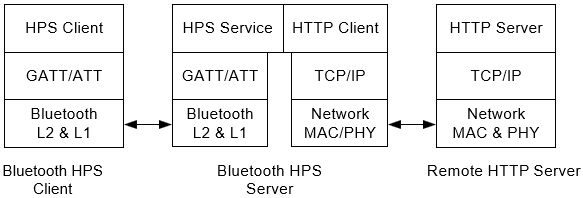
The HTTP Proxy Service (HPS) allows a device to expose HTTP Web services to a client of the HPS Server (HPS Client) using the Generic Attribute Profile (GATT). This enables an HPS Client device to program a set of characteristics that configures a Hyper Text Transfer Protocol (HTTP) request, initiate this request, and then read the response.
The HPS is designed to support HPS Client devices that are constrained in computing resources. The HPS Client software that uses HPS to reach remote HTTP Servers will be limited in the sizes of HTTP headers and entity bodies that they can generate and consume. From a practical standpoint, the HPS specification is intended for use by applications that will need relatively small headers and entity bodies, which can in turn fit within the Generic Attribute Profile (GATT) maximum characteristics size limits.
The device implementing the HPS server shall support GATT server role. As per Figure 1.1, the HPS Client would support the GATT Client role.
1.1. Conformance
If conformance to this service is claimed, all capabilities indicated as mandatory for this service shall be supported in the specified manner (process-mandatory). This also applies for all optional and conditional capabilities for which support is indicated. All mandatory capabilities, and optional and conditional capabilities for which support is indicated, are subject to verification as part of the Bluetooth qualification program.
1.2. Service Dependencies
This service is not dependent upon any other services.
1.3. Bluetooth Specification Release Compatibility
This specification is compatible with the Bluetooth Core Specification 4.0 [1].
1.4. GATT Sub-Procedure Requirements
Requirements in this section represent a minimum set of requirements for a Server.
Table 1.1 summarizes additional GATT sub-procedure requirements beyond those required by all GATT Servers.
|
GATT Sub-Procedure |
Requirements |
|---|---|
|
Read Long Characteristic Values |
M |
|
Write Characteristic Value |
M |
|
Write Long Characteristic Values |
M |
|
Notifications |
M |
|
Read Characteristic Descriptors |
M |
|
Write Characteristic Descriptors |
M |
1.5. Transport Dependencies
There are no transport restrictions imposed by this service specification.
Where the term BR/EDR is used throughout this document, this also includes the use of AMP.
1.6. Error Codes
This service defines the following Attribute Protocol (ATT) Application error code:
|
Name |
Error Code |
Description |
|---|---|---|
|
Request Already in Progress |
0x80 |
A HTTP Control Point request cannot be serviced because HPS is executing previously triggered HTTP request. |
|
Invalid Request |
0x81 |
A HTTP Control Point request cannot be serviced because content of the URI, the HTTP Headers or the HTTP Entity Body characteristics is not set correctly. |
|
Network Not Available |
0x82 |
Network connection not available |
HPS Server may reject HPS Client’s Write request to the URI (Universal Resource Identifier), HTTP Header, HTTP Body, or HTTP Control Point with “Insufficient Resources” result code if it cannot originate HTTP request to the HTTP Server.
1.7. Byte Transmission Order
All characteristics used with this service shall be transmitted with the least significant octet first (i.e., little endian). The least significant octet is identified in the characteristic definitions in [2].
2. Service Declaration
The HPS should be instantiated as a «Primary Service». There shall be up to one instance of the HPS on the device per Client. However, the device may support multiple simultaneous HTTP connections originated from multiple HPS Clients.
The service UUID shall be set to «HTTP Proxy Service» defined in [2].
3. Service Characteristics
The following characteristics are exposed in the HTTP Proxy Service. Only one instance of each characteristic is permitted within this service. The characteristic formats and UUIDs are defined in [2].
Where a characteristic can be notified, a Client Characteristic Configuration Descriptor shall be included in that characteristic as required by the Core Specification [1].
|
Characteristic Name |
Requirement |
Mandatory Properties |
Optional Propertie |
Security Permissions |
|---|---|---|---|---|
|
URI |
M |
Read, Write, Read Long, Write Long |
Optional |
|
|
HTTP Headers |
M |
Read, Write, Read Long, Write Long |
Optional |
|
|
HTTP Entity Body |
M |
Read, Write, Read Long, Write Long |
Optional |
|
|
HTTP Control Point |
M |
Write |
Optional |
|
|
HTTP Status Code |
M |
Notify |
Optional |
|
|
HTTPS Security |
M |
Read |
Optional |
Notes:
-
Security Permissions of “Optional” means that this service does not impose any requirements on security; the service can either require security or no security.
3.1. URI Characteristic
The URI characteristic is used to configure the URI for a subsequent request.
The URI characteristic is identified using the UUID «URI», as defined in [2].
The URI characteristic shall contain the URI to be used in the HTTP request as a UTF-8 string (utf8s), up to the maximum characteristic length defined.
Current version of the spec supports HTTP request with URI up to 512 octets in length.
3.1.1. Characteristic Behavior
The URI characteristic can be read or written while an HTTP request is not being executed. The behavior, if this characteristic is read or written while an HTTP request is being executed, is not defined.
3.2. HTTP Headers Characteristic
The HTTP Headers characteristic is used to hold the headers that would be sent with the HTTP Request or the headers contained within an HTTP response message from the HTTP Server.
The HTTP Header characteristic is identified using the UUID «HTTP Header», as defined in [2].
The HTTP Header characteristic shall contain the HTTP header to be used in the HTTP request as a UTF-8 string (utf8s), up to the maximum characteristic length defined.
Current version of the spec supports HTTP request with HTTP headers up to 512 octets in length.
3.2.1. Characteristic Behavior
The HTTP Headers characteristic can be read or written while an HTTP request is not being executed. The behavior, if this characteristic is read or written when an HTTP request is being executed, is not defined.
When written, the HTTP Headers shall be set to the general-header, request-header, and entity- header fields of an HTTP request.
When read, the HTTP Headers is set to the general-header, request-header and entity-header fields of an HTTP response; see 3.4.1.
The HPS Server shall notify the HPS Client that the HTTP Headers characteristic has been filled with data received from the HTTP Server using the Data Status field sent in the HTTP Status Code notification; see 3.5 .
If HTTP Headers received by the HPS Server in the HTTP response is more than 512 octets in length, the HPS Server shall store the first 512 octets of the received header in the HTTP Headers characteristic. The fact that the data field has been truncated shall be reflected in the Data Status field sent in the HTTP Status Code notification; see 3.5.
Note: the Server may add additional headers as it requires.
Note: the management of cookies should not be performed in the Server of the HTTP Proxy Service.
The Content-Length entity-header may not be included in the HTTP Headers; the Server may implicitly include this entity-header if it considers this header is necessary.
3.3. HTTP Entity Body Characteristic
The HTTP Entity Body characteristic contains the contents of the message-body after any Transfer-Encoding has been applied.
The HTTP Entity Body characteristic is identified using the UUID «HTTP Entity Body», as defined in [2].
The HTTP Entity Body characteristic shall contain the HTTP entity body used in the HTTP request as a UTF-8 string (utf8s), up to the maximum characteristic length defined.
Current version of the spec supports HTTP request with HTTP Entity Body up to 512 octets in length.
3.3.1. Behavior Description
This characteristic should not be written while an HTTP request is being executed, see 3.4.1. The behavior of this characteristic, if written when an HTTP request is being executed, is not defined.
The HTTP Entity Body is the entity-body of the HTTP request or the HTTP response.
The HPS Server shall notify the HPS Client that the HTTP Entity Body characteristic has been filled with data received from the HTTP Server using the Data Status field sent in the HTTP Status Code notification; see 3.5.
The value of the HTTP Entity Body characteristic when written by the Client shall be sent out as an HTTP message-body. An HTTP message-body received from an HTTP Server shall be stored by the HPS Server in the HTTP Entity Body characteristic.
If HTTP Entity Body received by the HPS Server in the HTTP response is more than 512 in length, the HPS Server shall store first 512 bytes of the response in the HTTP Entity Body characteristic. The fact that the data field has been truncated shall be reflected in the Data Status field sent in the HTTP Status Code notification; see 3.5.
Note: the Server may transform the entity-body into a message-body by applying a Transfer- Encoding. This may be implicitly performed by the Server to ensure safe and proper transfer of the message.
3.4. HTTP Control Point Characteristic
The HTTP Control Point is used to initiate a request to send an HTTP request message from the device containing the HTTP Proxy Service, acting as an HTTP Client, and an HTTP Server.
The HTTP Control Point characteristic is identified using the UUID «HTTP Control Point», as defined in [2].
The HTTP Control Point characteristic is one octet long (unit8) and identifies the HTTP request type. The HTTP Control Point supports the following commands:
|
Op Code Value |
Procedure |
|---|---|
|
0x00 |
Reserved for Future Use |
|
0x01 |
HTTP GET Request |
|
0x02 |
HTTP HEAD Request |
|
0x03 |
HTTP POST Request |
|
0x04 |
HTTP PUT Request |
|
0x05 |
HTTP DELETE Request |
|
0x06 |
HTTPS GET Request |
|
0x07 |
HTTPS HEAD Request |
|
0x08 |
HTTPS POST Request |
|
0x09 |
HTTPS PUT Request |
|
0x0a |
HTTPS DELETE Request |
|
0x0b |
HTTP Request Cancel |
|
0x0c-0xff |
Reserved for Future Use |
Note: support for the OPTIONS, TRACE, and CONNECT methods is not supported by the HTTP Control Point.
3.4.1. Behavioral Description
The HTTP Control Point is used by an HPS Client to initiate an HTTP or HTTPS request as defined by [3], or cancel an executing HTTP request.
When an HPS Client uses the Write Characteristic Value GATT sub-procedure with the HTTP GET Request, HTTP HEAD Request, HTTP POST Request, HTTP PUT Request, or HTTP DELETE Request opcode, then the HPS Server shall initiate an HTTP request, as defined by [3], and be considered to be executing the HTTP request. When an HPS Client uses the Write Characteristic Value GATT sub-procedure with the HTTPS GET Request, HTTPS HEAD Request, HTTPS POST Request, HTTPS PUT Request, or HTTPS DELETE Request opcode, then the Server shall initiate an HTTP request, as defined by [3] and [4], and be considered to be executing the HTTP request.
Only a single HTTP Request can be initiated by an HPS Client at the same time; only after a request has completed, can another request be initiated. The completion of an HTTP request is determined by the notification of the HTTP Status Code characteristic.
If the HPS was already executing an outstanding HTTP request when this sub-procedure is used, then the HPS Server shall reject the new HTTP Control Point write request with Request Already in Progress error code.
Exception: when an HPS Client uses the Write Characteristic Value GATT sub-procedure with the HTTP Request Cancel opcode, then the HPS Server shall terminate any executing HTTP request from this HPS Client.
Upon completing execution of an HTTP request, the Server shall notify the HTTP Status Code characteristic with the value of the Status-Code of the Status-Line of the first line of the HTTP Response message (for example 200 OK, or 404 RESOURCE NOT FOUND). The value of the associated HTTP characteristics shall contain the values from the HTTP Response message
3.4.2. Implicit Behavior
The Server should process the following Status-Code values and continue with the request as directed by [3]:
-
100 – Continue
-
101 – Switching Protocols
-
301 – Moved Permanently
-
302 – Found
-
303 – See Other
-
305 – Use Proxy
-
306 – Temporary Redirect
The HPS Server may impose a timeout on any request sent to the Internet. If this timeout expires, then the Status-Code 504 shall be used to notify that the HTTP request timed-out. The HPS Server can manage connections to the HTTP Server in any way that it wants. The use of persistent connections and message transmission requirements is out of scope of this specification.
Note: this behavior is abstracted away from the behavior of this Service.
The HPS Server can perform caching of HTTP resources as defined in [3] §13.
3.5. HTTP Status Code Characteristic
The HTTP Status Code characteristic contains the Status-Code from the Status-Line of the first line of the HTTP Response message, followed by one octet indicating the Data Status bit field indicating the status of the data received as defined in Table 3.5.
|
Data Status |
Value |
Description |
|---|---|---|
|
Headers Received |
0x01 |
If set, the response-headers and entity- headers field were received in the HTTP response and was stored in the HTTP Headers characteristic for the Client to read |
|
Headers Truncated |
0x02 |
If set, the response-headers and entity- headers field exceeded 512 octets in length and first 512 octets were saved in the HTTP Headers characteristic |
|
Body Received |
0x04 |
If set, the entity-body field was received in the HTTP response and was stored in the HTTP Entity Body characteristic for the Client to read |
|
Body Truncated |
0x08 |
If set, the entity-body field exceeded 512 octets in length and first 512 octets were saved in the HTTP Headers characteristic |
|
Reserved for Future Use |
0xF0 |
Reserved for Future Use |
The HTTP Control Point characteristic is identified using the UUID «HTTP Status Code», as defined in [2].
The HTTP Status Code characteristic value is 3 octets in length with first two-octets representing the Status Code encoded as uint16 based on the HTTP Status Code [3] followed by 1 octet Data Status bit field.
The structure of the HTTP Status Code characteristic is defined below:
|
LSO |
MSO |
|
Status Code |
Data Status |
|
|---|---|---|
|
Data type |
uint16 |
uint8 |
|
Size |
2 octets |
1 octet |
|
Units |
None |
None |
3.5.1. Behavior Description
This characteristic shall be notified when the HTTP request execution, initiated by using the HTTP Control Point behavior, has completed. The choice of whether the characteristic is notified is determined by the state of the Client Characteristic Configuration Descriptor.
3.6. HTTPS Security Characteristic
The HTTPS Security characteristic contains the known authenticity of the HTTP Server certificate for the URI.
The HTTP Control Point characteristic is identified using the UUID «HTTPS Security», as defined in [2].
The HTTPS Security characteristic is Boolean.
3.6.1. Behavior Description
Once an HTTPS GET Request, HTTPS HEAD Request, HTTPS POST Request, HTTPS PUT Request, or HTTPS DELETE Request has been written to the HTTP Control Point, the Server shall authenticate the HTTP Server certificate for the URI. The state of this authenticity shall be readable by the HPS Client before the HTTP Status Code is notified.
This GATT characteristic is Boolean: TRUE (0x01) and FALSE (0x00).
3.7. SDP Record
If this service is exposed over BR/EDR then it shall have the following SDP record.
|
Item |
Definition |
Type |
Value |
Status |
|---|---|---|---|---|
|
Service Class ID Lists |
M |
|||
|
Service Class #0 |
UUID |
«HTTP Proxy Service» |
M |
|
|
Protocol Descriptor List |
M |
|||
|
Protocol #0 |
UUID |
L2CAP |
M |
|
|
Parameter #0 for Protocol #0 |
Uint16 |
PSM = ATT |
M |
|
|
Protocol #1 |
UUID |
ATT |
M |
|
|
Parameter #0 for Protocol #1 |
GATT Start Handle |
Unit16 |
First handle of this services in the GATT database |
M |
|
Parameter #1 for Protocol #1 |
GATT End Handle |
Unit16 |
Last handle of this services in the GATT database |
M |
|
BrowseGroupList |
PublicBrowseRoot* |
M |
* Public Browse Root shall be present; however, other browse UUIDs may also be included in the list.
4. LE Connection Procedure
The HPS Server shall support at least one of the GAP Connectable modes as defined in [1]. In the GAP Connectable Mode the HPS Server should include the Service UUID «HTTP Proxy Service» defined in [2] in the Service UUIDs AD type field of the advertising data.
The HPS Server shall perform one of the GAP Connection Establishment procedures to the HPS Clients. The HPS Server shall connect to any device which includes the Service UUID «HTTP Proxy Service» defined in [2] in the Service Solicitation UUIDs AD type field of the advertisement data.
The HPS Client can be in the GAP Undirected or Directed Connectable mode. In the GAP Undirected Connectable Mode the HPS Client includes the Service UUID «HTTP Proxy Service» defined in [2] in the Service Solicitation UUIDs AD type field of the advertisement data.
The HPS Client can also perform GAP Connection Establishment procedure as defined in [1].
5. Appendix A: Samples MSCs (Informative)
The GATT exchange represented in the example shown in Figure 4.1, illustrates the sample interaction between an HPS Client and an HPS Server to perform an HTTP transaction.
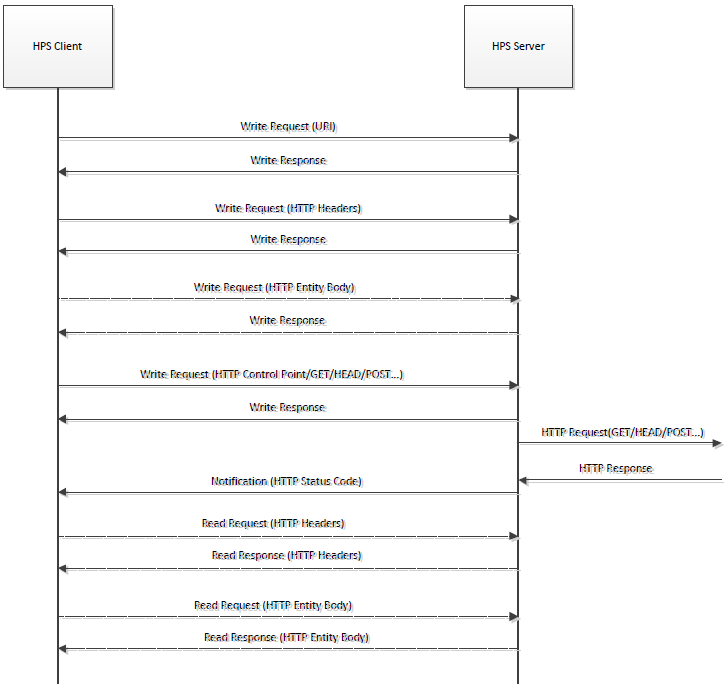
Note: Dotted lines depict HPS Client requests required for processing of some but not all HTTP requests.
6. Appendix B: Using HTTP for RFC-2616 and RFC- 2818 (Informative)
The following sections provide mapping between HPS characteristics and HTTP primitives when information is exchanged between an HPS and an HTTP Client implementing RFC-2616 [3], and to control use of a channel security entity defined in RFC-2818 [4].
6.1. URI - Universal Resource Identifier
The HTTP Client should use the contents of the URI characteristic (see Section 3.1) to construct the HTTP requests and responses.
6.2. HTTP Headers
The HTTP Client should use the contents of the HTTP Headers characteristic (see Section 3.2) to construct the Header portion of HTTP requests and responses.
6.3. HTTP Entity Body
The HTTP Entity Body characteristic may be used to construct or capture the HTTP Entity Body.
The Client of the HPS Server may write data directly to the HTTP Entity Body characteristic. The HTTP Client should use the contents of the HTTP Entity Body characteristic to construct an HTTP Entity Body for HTTP requests. The HTTP Client should use this characteristic to capture an incoming HTTP Entity Body from an HTTP response.
6.4. HTTP Control Point
The HTTP Client should use the HTTP Control Point characteristic to command the HTTP Proxy Service to execute the specified HTTP operation.
6.5. HTTP Status Code
The HTTP Client should capture the HTTP status code returned from the addressed HTTP Server, and load it into the HTTP Status Code characteristic.
6.6. HTTP Security
RFC-2818 [4] implements Transport Layer Security (TLS) over Internet Protocol. The HTTP Client should implement the behavior specified in Section 3.6.1.
7. Acronyms and Abbreviations
|
Abbreviation or Acronym |
Meaning |
|---|---|
|
ER |
Executing HTTP Request |
|
GAP |
Generic Access Profile |
|
GATT |
Generic Attribute Profile |
|
HPS |
HTTP Proxy Service |
|
HTTP |
Hypertext Transfer Protocol |
|
HTTPS |
Hypertext Transfer Protocol Secure |
|
RB |
Read Body |
|
RH |
Read Headers |
|
TLS |
Transport Layer Security |
|
URL |
Uniform Resource Locator |
|
URI |
Uniform Resource Identifier |
|
UUID |
Universally Unique Identifier |
8. References
Bibliography
[1] Bluetooth Core Specification, Version 4.0 or later
[2] Characteristic and Descriptor descriptions are accessible via the Bluetooth SIG Assigned Numbers
[3] IETF RFC 2616 Hypertext Transfer Protocol – HTTP/1.1
[4] IETF RFC 2818 HTTP Over TLS