|

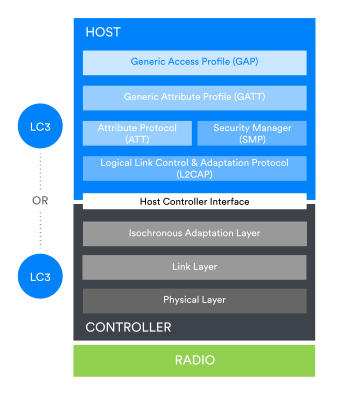
The Bluetooth data transport system follows a layered architecture. This description of the Bluetooth system describes the Bluetooth core transport layers up to and including L2CAP channels. All Bluetooth operational modes follow the same generic transport architecture.
For efficiency and legacy reasons, the Bluetooth transport architecture includes a sub-division of the logical layer, distinguishing between logical links and logical transports. This sub-division provides a general and commonly understood concept of a logical link that provides an independent transport between two or more devices. The logical transport sub-layer is required to describe the inter-dependence between some of the logical link types, mainly for reasons of legacy behavior.
The Bluetooth 1.1 specification described the ACL and SCO links as physical links. With the addition of extended SCO (eSCO) and for future expansion it is better to consider these as logical transport types, which more accurately encapsulates their purpose. However, they are not as independent as might be desired, due to their shared use of resources such as the LT_ADDR and acknowledgement/repeat request (ARQ) scheme. Hence the architecture is incapable of representing these logical transports with a single transport layer. The additional logical transport layer goes some way towards describing this behavior.
Core Traffic BearersThe Bluetooth core system provides a number of standard traffic bearers for the transport of service protocol and application data.
The logical links are named using the names of the associated logical transport and a suffix that indicates the type of data that is transported: C for control links carrying LMP messages, U for L2CAP links carrying user data (L2CAP PDUs) and S for stream links carrying unformatted synchronous or isochronous data. It is common for the suffix to be removed from the logical link without introducing ambiguity, thus a reference to the default ACL logical transport can be resolved to mean the ACL-C logical link in cases where the LMP protocol is being discussed, or the ACL-U logical link when the L2CAP layer is being discussed.
The mapping of application traffic types to Bluetooth core traffic bearers is based on matching the traffic characteristics with the bearer characteristics. It is recommended to use these mappings as they provide the most natural and efficient method of transporting the data with its given characteristics.
An application, or an implementation of the Bluetooth core system, may choose to use a different traffic bearer or a different mapping to achieve a similar result. For example, in a piconet with only one slave, the master may choose to transport L2CAP broadcasts over the ACL-U logical link rather than over the ASB-U or PSB-U logical links. This will probably be more efficient in terms of bandwidth if the physical channel quality is not too degraded. Use of alternative transport paths is only acceptable if the characteristics of the application traffic type are preserved.
Application traffic types are used to classify the types of data that may be submitted to the Bluetooth core system. The original data traffic type may not be the same as the type that is submitted to the Bluetooth core system if an intervening process modifies it. For example, video data is generated at a constant rate but an intermediate coding process may alter this to variable rate, e.g. by MPEG4 encoding. For the purposes of the Bluetooth core system, only the characteristic of the submitted data is of interest.
Framed Data Traffic The L2CAP layer services provide a frame-oriented transport for asynchronous and isochronous user data. The application submits data to this service in variable-sized frames (up to a negotiated maximum for the channel) and these frames are delivered in the same form to the corresponding application on the remote device. There is no requirement for the application to insert additional framing information into the data, although it may do so if this is required. (Such framing is invisible to the Bluetooth core system.)
Connection-oriented L2CAP channels may be created for transport of unicast (point-to-point) data between two Bluetooth enabled devices. A connectionless L2CAP channel exists for broadcasting data. In the case of piconet topologies the master device is always the source of broadcast data and the slave device(s) are the recipients. Traffic on the broadcast L2CAP channel is uni-directional. Unicast L2CAP channels may be uni-directional or bi-directional.
L2CAP channels have an associated QoS setting that defines constraints on the delivery of the frames of data. These QoS settings may be used to indicate, for example, that the data is isochronous and therefore has a limited lifetime after which it becomes invalid, that the data should be delivered within a given time period, or that the data is reliable and should be delivered without error, however long this takes.
The L2CAP channel manager is responsible for arranging to transport theL2CAP channel data frames on an appropriate baseband logical link, possibly multiplexing this onto the baseband logical link with other L2CAP channels with similar characteristics.
Top
Unframed Data TrafficIf the application does not require delivery of data in frames, possibly because it includes in-stream framing, or because the data is a pure stream, then it may avoid the use of L2CAP channels and make direct use of a baseband logical link.
The Bluetooth core system supports the direct transport of application data that is isochronous and of a constant rate (either bit-rate or frame-rate for preframed data), using a SCO-S or eSCO-S logical link. These logical links reserve physical channel bandwidth and provide a constant rate transport locked to the piconet clock. Data is transported in fixed size packets at fixed intervals with both of these parameters negotiated during channel establishment. eSCO links provide a greater choice of bit-rates and also provide greater reliability by using limited retransmission in case of error. Enhanced Data Rate operation is supported for eSCO, but not for SCO logical transports. SCO and eSCO logical transports do not support multiplexed logical links or any further layering within the Bluetooth core. An application may choose to layer a number of streams within the submitted SCO/eSCO stream, provided that the submitted stream is, or has the appearance of being, a constant rate stream.
The application chooses the most appropriate type of logical link from those available at the baseband, creates and configures it to transport the data stream and releases it when completed. (The application will normally also use a framed L2CAP unicast channel to transport its C-plane information to the peer application on the remote device.)
If the application data is isochronous and of a variable rate, then this may only be carried by the L2CAP unicast channel, and hence will be treated as framed data.
Reliability of Traffic BearersBluetooth technology is a wireless communications system. In poor RF environments, this system should be considered inherently unreliable. To counteract this the system provides levels of protection at each layer. The baseband packet header uses forward error correcting (FEC) coding to allow error correction by the receiver and a header error check (HEC) to detect errors remaining after correction. Certain Baseband packet types include FEC for the payload. Furthermore, some baseband packet types include a cyclic redundancy error check (CRC).
On ACL logical transports the results of the error detection algorithm are used to drive a simple ARQ protocol. This provides an enhanced reliability by re-transmitting packets that do not pass the receiver’s error checking algorithm. It is possible to modify this scheme to support latency-sensitive packets by discarding an unsuccessfully transmitted packet at the transmitter if the packet’s useful life has expired. eSCO links use a modified version of this scheme to improve reliability by allowing a limited number of retransmissions.
The resulting reliability gained by this ARQ scheme is only as dependable as the ability of the HEC and CRC codes to detect errors. In most cases this is sufficient, however it has been shown that for the longer packet types the probability of an undetected error is too high to support typical applications, especially those with a large amount of data being transferred.
The L2CAP layer provides an additional level of error control that is designed to detect the occasional undetected errors in the baseband layer and request retransmission of the affected data. This provides the level of reliability required by typical Bluetooth applications.
Broadcast links have no feedback route, and are unable to use the ARQ scheme (although the receiver is still able to detect errors in received packets). Instead each packet is transmitted several times in the hope that the receiver is able to receive at least one of the copies successfully. Despite this approach there are still no guarantees of successful receipt, and so these links are considered unreliable.
In summary, if a link or channel is characterized as reliable this means that the receiver is capable of detecting errors in received packets and requesting retransmission until the errors are removed. Due to the error detection system used some residual (undetected) errors may still remain in the received data. For L2CAP channels the level of these is comparable to other communication systems, although for logical links the residual error level is somewhat higher.
The transmitter may remove packets from the transmit queue such that the receiver does not receive all the packets in the sequence. If this happens detection of the missing packets is delegated to the L2CAP layer.
On an unreliable link the receiver is capable of detecting errors in received packets but cannot request retransmission. The packets passed on by the receiver may be without error, but there is no guarantee that all packets in the sequence are received. Hence the link is considered fundamentally unreliable. There are limited uses for such links, and these uses are normally dependent on the continuous repetition of data from the higher layers while it is valid.
Stream links have a reliability characteristic somewhere between a reliable and an unreliable link, depending on the current operating conditions.
Top
Transport Architecture Entities
Bluetooth Generic Packet StructureThe general packet structure reflects the architectural layers found in the Bluetooth system. The packet structure is designed for optimal use in normal operation.
Packets normally only include the fields that are necessary to represent the layers required by the transaction. Thus a simple inquiry request over an inquiry scan physical channel does not create or require a logical link or higher layer and therefore consists only of the channel access code (associated with the physical channel). General communication within a piconet uses packets that include all of the fields, as all of the architectural layers are used.
All packets include the channel access code. This is used to identify communications on a particular physical channel, and to exclude or ignore packets on a different physical channel that happens to be using the same RF carrier in physical proximity.
There is no direct field within the Bluetooth packet structure that represents or contains information relating to physical links. This information is implied in the logical transport address (LT_ADDR) carried in the packet header.
Most packets include a packet header. The packet header is always present in packets transmitted on physical channels that support physical links, logical transports and logical links. The packet header carries the LT_ADDR, which is used by each receiving device to determine if the packet is addressed to the device and is used to route the packet internally.
The packet header also carries part of the LC protocol that is operated per logical transport (except for ACL and SCO transports that operate a shared LC protocol carried on either logical transport).
The EDR packets have a guard time and synchronization sequence before the payload. This is a field used for physical layer change of modulation scheme.
The payload header is present in all packets on logical transports that support multiple logical links. The payload header includes a logical link identifier field used for routing the payload and a field indicating the length of the payload. Some packet types also include a CRC after the packet payload that is used to detect most errors in received packets. EDR packets have a trailer after the CRC.
The packet payload is used to transport the user data. The interpretation of this data is dependent on the logical transport and logical link identifiers. For ACL logical transports LMP messages and L2CAP signals are transported in the packet payload, along with general user data from applications. For SCO and eSCO logical transports the payload contains the user data for the logical link.
Physical ChannelsThe lowest architectural layer in the Bluetooth wireless technology system is the physical channel. A number of types of physical channels are defined. All Bluetooth physical channels are characterized by an RF frequency combined with temporal parameters and restricted by spatial considerations. For the basic and adapted piconet physical channels, frequency hopping is used to change frequency periodically to reduce the effects of interference and for regulatory reasons.
Two Bluetooth enabled devices use a shared physical channel for communication. To achieve this their transceivers need to be tuned to the same RF frequency at the same time, and they need to be within a nominal range of each other.
Given that the number of RF carriers is limited and that many Bluetooth enabled devices may be operating independently within the same spatial and temporal area, there is a strong likelihood of two independent Bluetooth enabled devices having their transceivers tuned to the same RF carrier, resulting in a physical channel collision. To mitigate the unwanted effects of this collision each transmission on a physical channel starts with an access code that is used as a correlation code by devices tuned to the physical channel. This channel access code is a property of the physical channel. The access code is always present at the start of every transmitted packet.
Four Bluetooth physical channels are defined. Each is optimized and used for a different purpose. Two of these physical channels (the basic piconet channel and adapted piconet channel) are used for communication between connected devices and are associated with a specific piconet. The remaining physical channels are used for discovering Bluetooth enabled devices (the inquiry scan channel) and for connecting Bluetooth enabled devices (the page scan channel).
A Bluetooth enabled device can only use one of these physical channels at any given time. In order to support mul |